What Is a Mascot? Meaning, Types and Famous Brand Mascots
By the Charmotion team · Updated · How we write guides
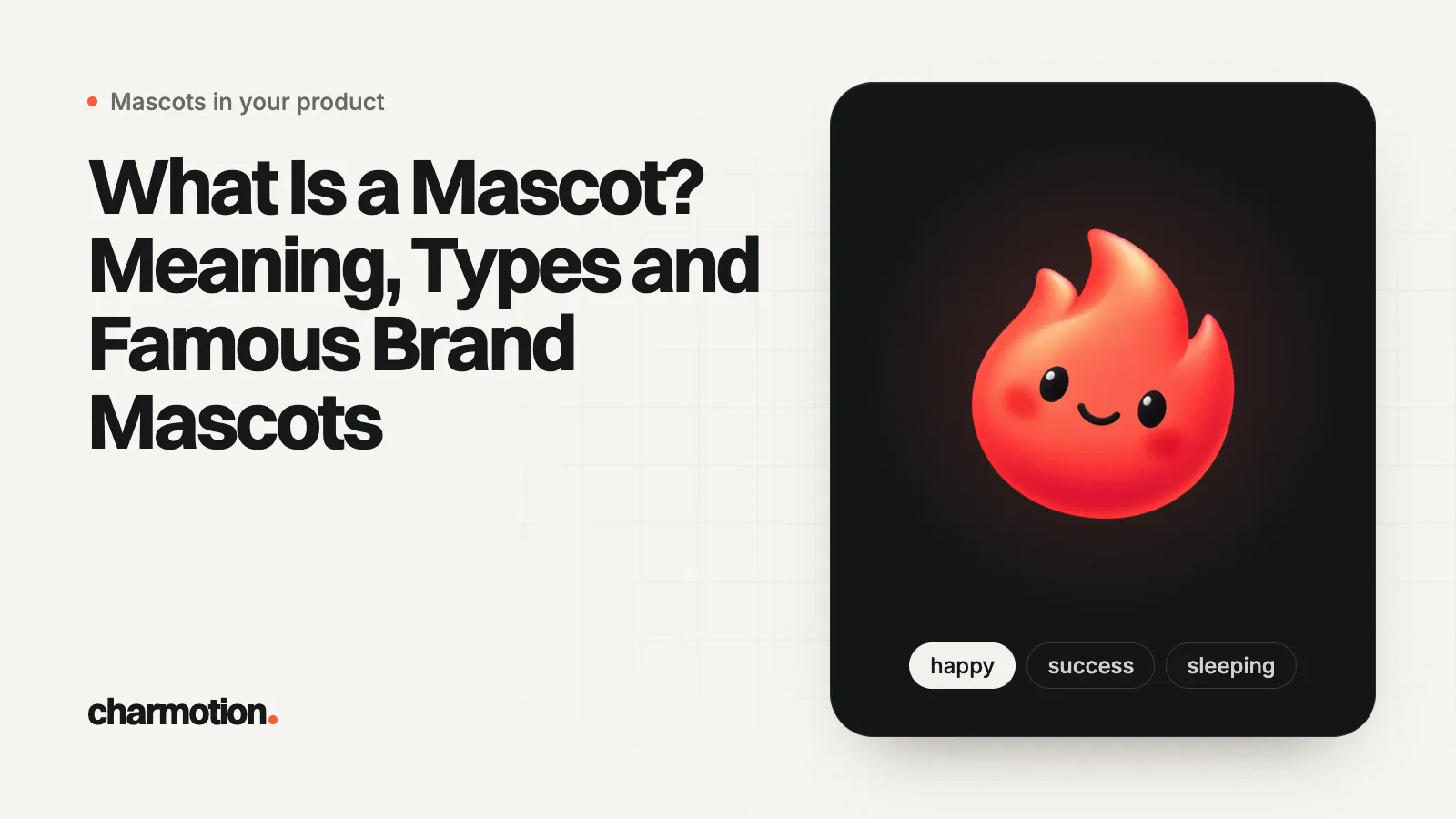
A mascot is a character, animal, person or object that a team, school, brand or event adopts as its symbol, originally because it was believed to bring good luck. Brand mascots such as Michelin's Bibendum (1898) and Duolingo's green owl Duo give a company a face people recognize, remember and can watch act.
Key takeaways
- Dictionaries define a mascot as an animal, person or thing a group adopts as its symbol and that is supposed to bring luck.
- The word comes from French mascotte (Provençal mascoto, a charm) and spread through Audran's 1880 operetta La mascotte.
- The main types are sports and school, brand, event and Olympic, and app or tech mascots; each can be a costume, an illustration or both.
- A logo identifies a brand and stays fixed; a mascot is a character that can pose, react and speak.
- Today a mascot is designed first (brief, silhouette, master pose, rules), then animated for the places it appears.
Already have a character or logo? See examples in real app screens: splash, onboarding, loading and empty-state screens, with the animation that plays in each.
What does mascot mean?
Dictionary.com defines a mascot as "an animal, person, or thing adopted by a group as its representative symbol and supposed to bring good luck." Collins, quoted on the same page, keeps only the luck part: "a person, animal, or thing considered to bring good luck." In everyday use the luck has faded. A mascot today is the character that stands for a team, school, company, product or event.
Where does the word mascot come from?
Dictionary.com traces it to French mascotte, from Provençal mascoto ("talisman, charm"), a derivative of masco ("sorceress"), and dates the English word to 1880 to 1885. The word spread thanks to an operetta: Edmond Audran's La mascotte opened at the Théâtre des Bouffes Parisiens in Paris on 28 December 1880, and its plot follows a "mascotte" whose presence brings good luck to the Italian farmer she lives with. The Oxford Dictionary of Word Origins, cited by Wikipedia, credits it with bringing "mascot" into English the next year.
What are the different types of mascots?
Mascots sort by who owns them and where they appear. The same character can belong to more than one row.
| Type | Job | Typical form | Examples |
|---|---|---|---|
| Sports and school mascots | Team spirit, crowd energy, a symbol on jerseys and merchandise | A costumed performer at games plus an emblem logo | College and pro team characters; esports teams such as Team Liquid, whose horse goes back to a 2001 site banner |
| Brand or corporate mascots | Recognition and memory across ads, packaging and products | Illustrated or 3D character, sometimes inside the logo | Michelin's Bibendum, Planters' Mr. Peanut, Mailchimp's Freddie |
| Event and Olympic mascots | A friendly face for one edition, merchandise, outreach to children | Character design plus costumes and toys | Waldi (Munich 1972), Tina and Milo (Milano Cortina 2026) |
| App and tech mascots | Onboarding, feedback, empty states, community identity | Illustration and animation inside the product | Duolingo's Duo, the Go gopher, the Android robot, GitHub's Octocat |
Event and Olympic mascots
The IOC counts Schuss, a skier at the Grenoble 1968 Winter Games, as the first Olympic mascot but an unofficial one; Waldi, a dachshund created for Munich 1972, was the first official Olympic mascot. For Milano Cortina 2026, the mascots are two stoats, Tina (Olympic) and Milo (Paralympic). Students submitted over 1,600 ideas, the design came from a school in Taverna, Calabria, and the finalists went to a public poll.
App and tech mascots
Software has its own tradition. The Go gopher, drawn by Renee French, became Go's mascot at the open-source launch in 2009 and is licensed under Creative Commons Attribution 4.0. Google lets anyone reproduce or modify the green Android robot under a Creative Commons 3.0 Attribution license, while keeping the trademark rights. GitHub calls Mona, "part cat, part octopus," its official mascot. Whether your own product needs one is a separate question: see should your app have a mascot.
Costume mascots vs illustrated characters
A costume mascot is a performer in a full suit at games, store openings and events. It needs a design that survives being built in foam and fabric: a big head, readable eyes, no thin parts. An illustrated mascot lives in print and on screens, where it can be tiny, animated and redrawn in any pose. Many organizations have both, designed from the same master drawing.
What are the most famous brand mascots?
A few characters show how long a well-designed mascot can last, and how it changes over time.
| Mascot | Brand | Origin | What changed |
|---|---|---|---|
| Bibendum (the Michelin Man) | Michelin | Drawn with cartoonist O'Galop (Marius Rossillon); unveiled at the first Paris Motor Show in 1898. The name comes from the slogan "Nunc est bibendum." | Lost the cigar and glasses, slimmed down and switched from bike tires to thicker truck tires. Michelin says the Financial Times voted him "the best logo of all time" in 2000. |
| Mr. Peanut | Planters | Planters held a contest in 1916; a 13-year-old, Antonio Gentile of Suffolk, Virginia, won with his sketch. | Planters describes the winning sketch as a cheerful peanut with limbs and a cane; the character still fronts the brand. |
| Colonel Sanders | KFC | A real person, the founder, used as the brand face. | In November 2006 KFC put him in a red cook's apron to stress, in its words, "the realness of Colonel Sanders and the fact that he was a chef." |
| Freddie | Mailchimp | A chimp who is "always winking because he has a great attitude." | Collins' 2018 rebrand paired a new wordmark with "a more simplified Freddie." |
| Duo | Duolingo | A green owl, with Duolingo "from the beginning." | Reshaped in 2013 for "a single consistent design" across platforms. |
| Snoo | Sketched by co-founder Alexis Ohanian as a student at the University of Virginia. | The 2023 rebrand made Snoo a 3D character and put just its head in a chat bubble as the logo. |
The pattern is the same in every row: the character keeps its core shape and colors while the drawing is simplified for new media. How these characters work inside logos is covered in mascot logo examples and design rules.
Why do brands use mascots?
A mascot does things a logo cannot. It can wave, explain, celebrate, look sorry and appear in a hundred situations while staying recognizable. Typical reasons brands give:
- Recognition and memory. A recurring character links years of ads, packaging and posts to one brand.
- A human face for a product, especially an abstract one such as software, finance or tires.
- A voice. Onboarding tips, success messages and error states feel friendlier from a character.
- Merchandise and community. Stickers, plush toys, costumes and fan art are easier with a character than with a wordmark.
The best-known numbers come from advertising research and should be quoted as such. In an Advertising Week article, Jon Evans of System1 (which sells ad testing) cites research from Orlando Wood and the IPA finding that campaigns featuring a recurring character or "fluent device" are "73% more likely to report a large profit gain," and consumer testing of Super Bowl ads, cited in the same article, in which fluent devices averaged 3.8 stars against 2.7 for celebrity ads. These figures describe advertising campaigns, not app mascots; our evidence guide explains the limits.
Mascots also have a cost: they must be kept consistent, and they do not fit every message. GitHub's brand rules say "less is more" and keep its mascots away from "money, security, sales, enterprise offerings, apologies, politics or crises." For tone by category, see mascot tone by industry.
What is the difference between a mascot, a logo and an avatar?
| Logo | Mascot | Avatar | |
|---|---|---|---|
| What it is | The mark that identifies the brand | A character with a personality that represents the brand | A picture or character that represents a user, or an AI assistant, inside an interface |
| Changes? | No. Brands forbid altering it | Yes. New poses, expressions and scenes within its rules | Often personalized or generated per user |
| Where it appears | Everywhere the brand is named | Campaigns, product moments, events, merchandise | Profiles, chat, games, virtual meetings |
| Example | GitHub's Invertocat | GitHub's Mona, the Octocat | A user's profile picture |
The line between the first two is clear in brand rules. GitHub says its Invertocat pictogram "represents our mascot, the Octocat," but also: "Don't use our illustration, mascots or Mona as a substitute for the logo." Mailchimp asks people not to alter its logo files at all. When a character is drawn as the logo itself, you have a mascot logo: a fixed, simplified version of the character that follows logo rules.
Avatars overlap with mascots when a product gives its AI assistant a branded character; see AI assistant avatar animation for that case.
How is a mascot made today?
The process has two halves: design the character once, carefully, then animate it for the places it lives.
- Brief. The mascot's job, where it appears, three personality traits and a list of things it never does.
- Concepts. Rough sketches or AI explorations of several directions; pick one.
- Silhouette and small-size test. Duolingo's design team wrote that "if the overall shape is not appealing, then the details within that shape can't compliment it successfully." Fill the design in black and view it at icon size.
- Master pose and rules. A front-facing master drawing, colors, an expression sheet and do and don't examples.
- Rights. Written ownership from whoever drew it, and a trademark clearance search. The USPTO warns that applications are often refused when a mark is too similar to an existing one.
- Animation. A small set of states for products (idle, greeting, loading, success) or short clips for social.
Each step is covered in detail in how to create a brand mascot, with prices in brand mascot design cost and AI design tools in best AI mascot generators.
How are app mascots animated?
Product teams often use interactive animation files rather than videos, so code can switch the character between states. Duolingo, for example, animates its World Characters in Rive, whose state machine it describes as "a visual representation of the logic that connects the animations ("states") together." Mascot animation states lists the set most products need.
Disclosure: Charmotion is our product. We list it where it fits and say where other tools are better; every other fact links to its source.
Charmotion covers the animation half for app and website mascots. You upload one PNG, JPEG or WebP of your character, or generate a design with AI (the Free plan includes 2 credits for AI designs), and get a Rive file with a state machine plus web, React and SwiftUI code. MP4 (1080x1080, 60 fps), a 480 px GIF, transparent WebM and MOV are exported on demand. It does not do lip-sync, walk cycles, sprite sheets, Lottie export or Live2D; for a costume, a 3D campaign character or acted scenes, a studio is the better choice. See example app screens.
Make a mascot from idea to animation
- Define the job. Write where the mascot appears, what it does there and who it speaks to.
- Write a personality brief. Pick a form (animal, object or creature), three traits and a short never list.
- Explore and choose one direction. Sketch or generate several concepts, then commit to one instead of polishing many.
- Test the silhouette and small sizes. Fill the character in solid black and view it at icon size; simplify anything that disappears.
- Lock the master pose and rules. Draw a front-facing master, fix the colors and add an expression sheet with do and don't examples.
- Clear the rights. Get written ownership of the artwork and run a trademark search on the name and design.
- Animate the states you need. Start with idle, greeting, loading and success for products, or short clips for social.
Frequently asked questions
What was the first Olympic mascot?
Schuss, a small skier at the Grenoble 1968 Winter Games, was the first Olympic mascot but an unofficial one. Waldi, a dachshund created for the Munich 1972 Games, was the first official Olympic mascot, according to the IOC.
Does a mascot have to be an animal?
No. Mascots can be people (Colonel Sanders), objects (Bibendum is made of tires, Mr. Peanut is a peanut), creatures (Reddit's Snoo) or animals (Duo, Freddie). Pick a form linked to your product or name that competitors are not already using.
What is a mascot costume?
A mascot costume is a full-body suit, usually with an oversized head, worn by a performer at games, events and store openings. It is built from the same master design as the illustrated mascot, so simple shapes and large, readable eyes work best.
Can a mascot be trademarked?
Yes, a mascot used to identify your goods or services can be registered as a trademark, like a logo. The USPTO advises a clearance search first, because a mark too similar to an existing one is a common reason applications are refused. This is general information, not legal advice.
Is a mascot the same as a logo?
No. A logo is the fixed mark that identifies a brand; a mascot is a character that can pose, react and appear in scenes. Some brands draw a simplified version of the mascot as the logo, which is called a mascot logo.
Quick answers from this guide
Sources
- Mascot (definition and word origin), Dictionary.com
- La mascotte (operetta by Edmond Audran), Wikipedia
- Olympic Games mascots, International Olympic Committee
- Munich 1972 mascot: Waldi, Olympics.com
- Milano Cortina 2026 unveils Paralympic and Olympic mascots, Milo and Tina, International Paralympic Committee
- Michelin Man origin, Michelin
- When was Mr. Peanut created?, Planters
- New KFC logo: it's all about the Colonel (November 2006), NBC News / Associated Press
- Brand assets (logo and Freddie usage), Mailchimp
- Collins gives Mailchimp a new brand system (September 2018), It's Nice That
- Reshaping Duo (November 2013), Duolingo Blog
- Reddit rebrand refreshes its logo (November 2023), TechCrunch
- The Go gopher, The Go Blog
- Brand guidelines (Android robot), Android Developers
- Logo (Invertocat and wordmark), GitHub Brand Toolkit
- Mascots, GitHub Brand Toolkit
- The history of the Team Liquid logo (July 2019), Team Liquid
- Celebrities v. fluent devices: how recurring brand characters drive lasting consumer connections, Advertising Week (Jon Evans, System1)
- Why search for similar trademarks, USPTO
- How Duolingo animates its World Characters (November 2022), Duolingo Blog
- How Charmotion works, Charmotion