How to Create a Mascot for Your Brand, Step by Step
By the Charmotion team · Updated · How we write guides
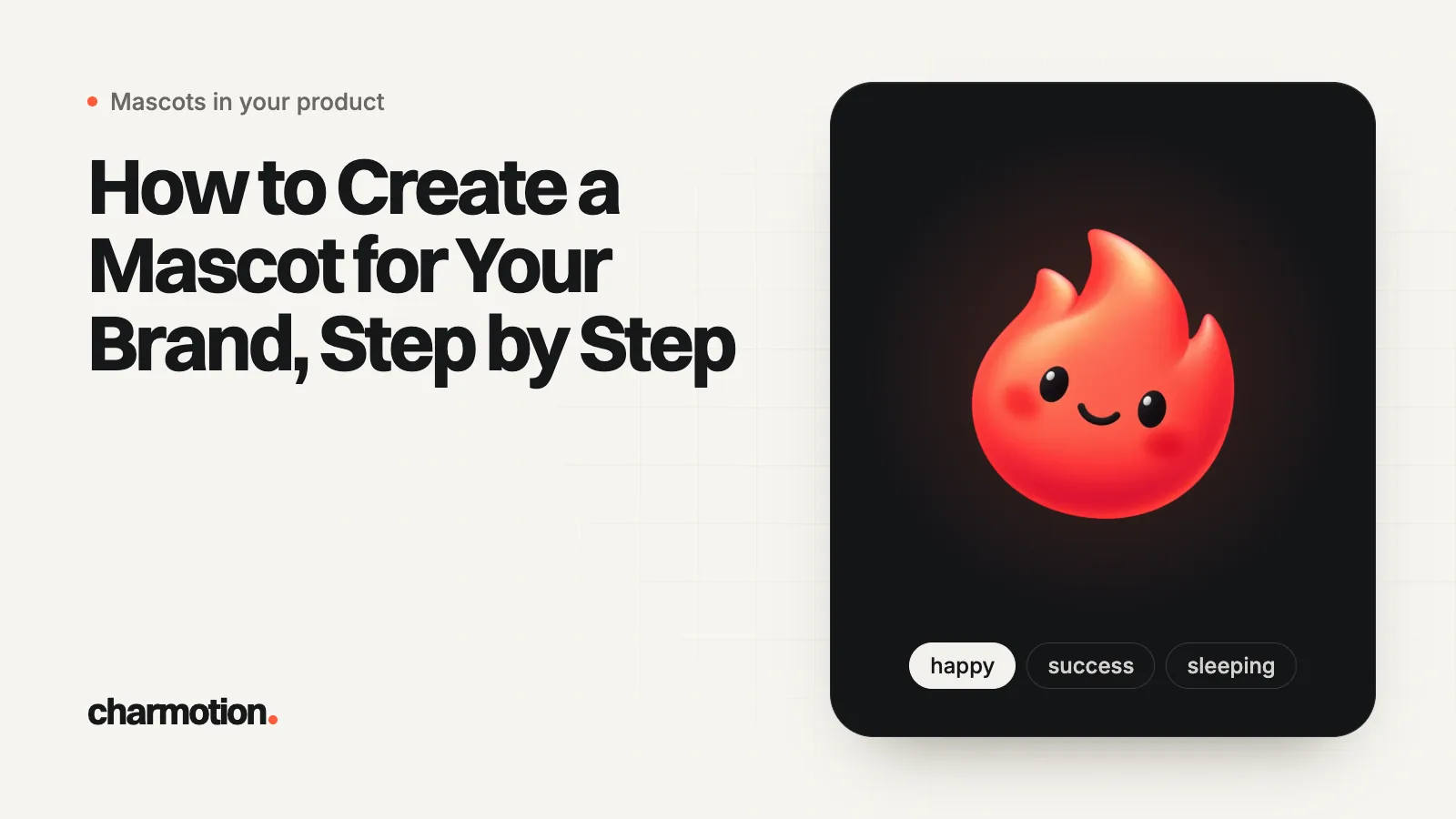
To create a mascot for your brand, decide what job it does and where it appears, give it a short personality brief, then design a simple character with a clear silhouette that works from a favicon to a billboard. Get written ownership of the design, check trademarks, write usage rules, and plan the few animated states it needs.
Key takeaways
- Start with the mascot's job and channels, not the drawing.
- Three personality traits and a list of things it never does keep it consistent.
- Duolingo's team calls the silhouette the most important part of a mascot's shape.
- A commissioned illustration is usually not a work made for hire, so get a written copyright assignment.
- Purely AI-generated imagery may not be protected by U.S. copyright; human changes and arrangement can be.
Already have a character or logo? See examples in real app screens: splash, onboarding, loading and empty-state screens, with the animation that plays in each.
What job should a brand mascot do?
A mascot earns its place when it has work to do. Write down, in one line each:
- Where it appears: app screens, website, packaging, social, events, support chat.
- What it does there: welcomes new users, waits with people during loading, celebrates success, softens errors, fronts campaigns.
- Who it speaks to, and what that audience should feel.
- How you will know it works: a metric such as onboarding completion, or a brand goal such as recognition in social posts.
A clear job also keeps the scope honest. A mascot that only appears on a homepage needs one strong pose; one that lives inside an app needs expressions and animated states, which changes the budget and the brief you give a designer.
If you cannot fill this in, a mascot may not be the right investment yet. Our guide on whether your app should have a mascot sorts the evidence, and mascot tone by industry covers where playful characters help and where they cost credibility.
How do I define a mascot's personality?
Write a one-page brief before anyone draws:
- Species or form. Animal, object, creature or abstract shape. Pick something linked to your product or name, but avoid what every competitor already uses.
- Three traits, for example curious, calm and a little cheeky. Each should map to your brand voice.
- Never list: things it does not do (mock users, appear in bad-news messages, wink at serious topics).
- A name that is short, easy to say in your main markets, and checked against trademarks (see below).
- A signature detail that people remember. Mailchimp describes Freddie as always winking.
How do I design a mascot that works at every size?
Duolingo's team wrote that "the most important part of Duo's reshaping was, obviously, Duo's shape/silhouette," because "if the overall shape is not appealing, then the details within that shape can't compliment it successfully." Practical rules that follow:
- Silhouette test: fill the character in solid black. It should still be recognizable.
- Few, simple shapes and two or three main colors from your palette.
- Small-size test: view it at 32 px. Thin lines, small text and tiny accessories disappear.
- Front-facing master pose with eyes and mouth clearly visible. It reads best in UI and is easiest to animate.
- Separate parts (head, eyes, mouth, arms) in the source file, so an animator can move them without repainting.
- No lettering on the character itself; put the brand name next to it.
Ask for a few rough concepts first, choose one direction, then refine. Polishing three finished characters wastes most of the budget. Before you approve the final design, put it into real layouts: your app header, a social avatar, a loading screen and a printed sticker. Problems show up in context that never appear on a white artboard.
Should I hire a designer, run a contest or use AI to create a mascot?
| Route | Best when | Watch out for |
|---|---|---|
| Freelance illustrator | You want a collaborator and several rounds of refinement | Contract must transfer copyright and include source files |
| Design contest (e.g. 99designs) | You want many directions quickly at a fixed price | Concepts vary widely; check originality |
| Branding or character studio | The mascot is part of a full identity or a 3D character | Highest cost and longest timeline |
| AI image generator | Exploring directions, or a low budget | Weaker copyright position; inconsistent results across poses |
Typical prices for each route are in brand mascot design cost. A common, sensible mix is to explore with AI or quick sketches, then have a person draw the final master so you own a clean, consistent design.
Who owns a mascot, and can I trademark it?
- Copyright from a freelancer. The U.S. Copyright Office explains that a commissioned work is a work made for hire only if it falls into one of nine listed categories and both sides sign a written agreement. A standalone mascot illustration usually does not fit those categories, so ask for a written assignment of copyright, plus the editable source files.
- AI-generated designs. The Copyright Office's January 2025 report concludes that prompts alone do not give enough human control for copyright, while human-authored expression, and creative selection, arrangement or modification of AI output, can be protected. Redrawing and refining an AI concept by hand strengthens your position. Our guide on AI-generated logo copyright and trademark goes deeper.
- Trademark. A mascot used to identify your brand can be registered as a trademark. The USPTO recommends searching for similar existing marks before you file, because a likely conflict can sink the application. Search the name and the character design.
This is general information, not legal advice; for a mascot you plan to invest in, a short consultation with a trademark attorney is cheap insurance.
What goes into a mascot style guide?
- Master pose and turnaround (front, three-quarter, side, back) if it will appear in more than one view.
- Expression sheet: neutral, happy, surprised, thinking, sad. See the mascot expression sheet page for a format.
- Exact colors as HEX and CMYK, and line weights.
- Minimum size and clear space.
- Do and don't examples. Mailchimp's public brand page, for example, always pairs the company name with Freddie, asks for plenty of space around him, and forbids altering the files.
- Voice: a few sample lines for onboarding, success and errors.
How do I bring a brand mascot to life with animation?
Plan a small set of states before animating anything: an idle loop for every screen, a greeting, a loading or thinking loop, and a success reaction cover most products. Mascot animation states lists what each one is for, and mascot animation cost shows what hand-made sets cost.
Disclosure: Charmotion is our product. We list it where it fits and say where other tools are better; every other fact links to its source.
Charmotion can design a character with AI from a text description (1 credit; the Free plan includes 2 credits for AI designs) or start from your finished PNG, JPEG or WebP, and animates it in its own artwork: idle, launch, happy, wave and loading, 1 credit each on Starter ($9 a month). You get a .riv file with web, React and SwiftUI code, plus video exports. It does not do talking, walk cycles or custom acting; for those, hire an animator.
Frequently asked questions
How long does it take to create a brand mascot?
A focused project with one illustrator often runs a few weeks: brief, rough concepts, one chosen direction, refinement and final files. Adding a turnaround, an expression sheet, 3D or animation extends it. Contests compress the concept stage into days but still need refinement afterwards.
Should my mascot be an animal?
Not necessarily. Animals are common because they read quickly and avoid human likeness issues, but objects, creatures and abstract shapes work too. Choose a form tied to your product or name that competitors in your category are not already using.
Can I use an AI-generated mascot for my brand?
You can use it, but your legal protection may be thin if the image is purely AI-generated. Check the generator's terms, run a trademark search, and have a person refine or redraw the final design so it includes human authorship you can document.
How many expressions does a mascot need?
Five covers most brands: neutral, happy, surprised, thinking and sad or sorry. Add more only when a real use appears, such as a celebration for a milestone or a sleeping pose for an empty state.
Quick answers from this guide
Sources
- Reshaping Duo, Duolingo Blog
- Brand assets (Freddie usage rules), Mailchimp
- Circular 30: Works Made for Hire, U.S. Copyright Office
- Copyright and Artificial Intelligence, Part 2: Copyrightability (January 2025), U.S. Copyright Office
- Why search for similar trademarks, USPTO
- Character or mascot design contests, 99designs
- How much does character design cost? (updated Aug 16, 2026), Pixune (a studio)
- How Charmotion works, Charmotion
- Charmotion pricing, Charmotion