Should Your AI Product Have a Mascot? Character vs Orb
By the Charmotion team · Updated
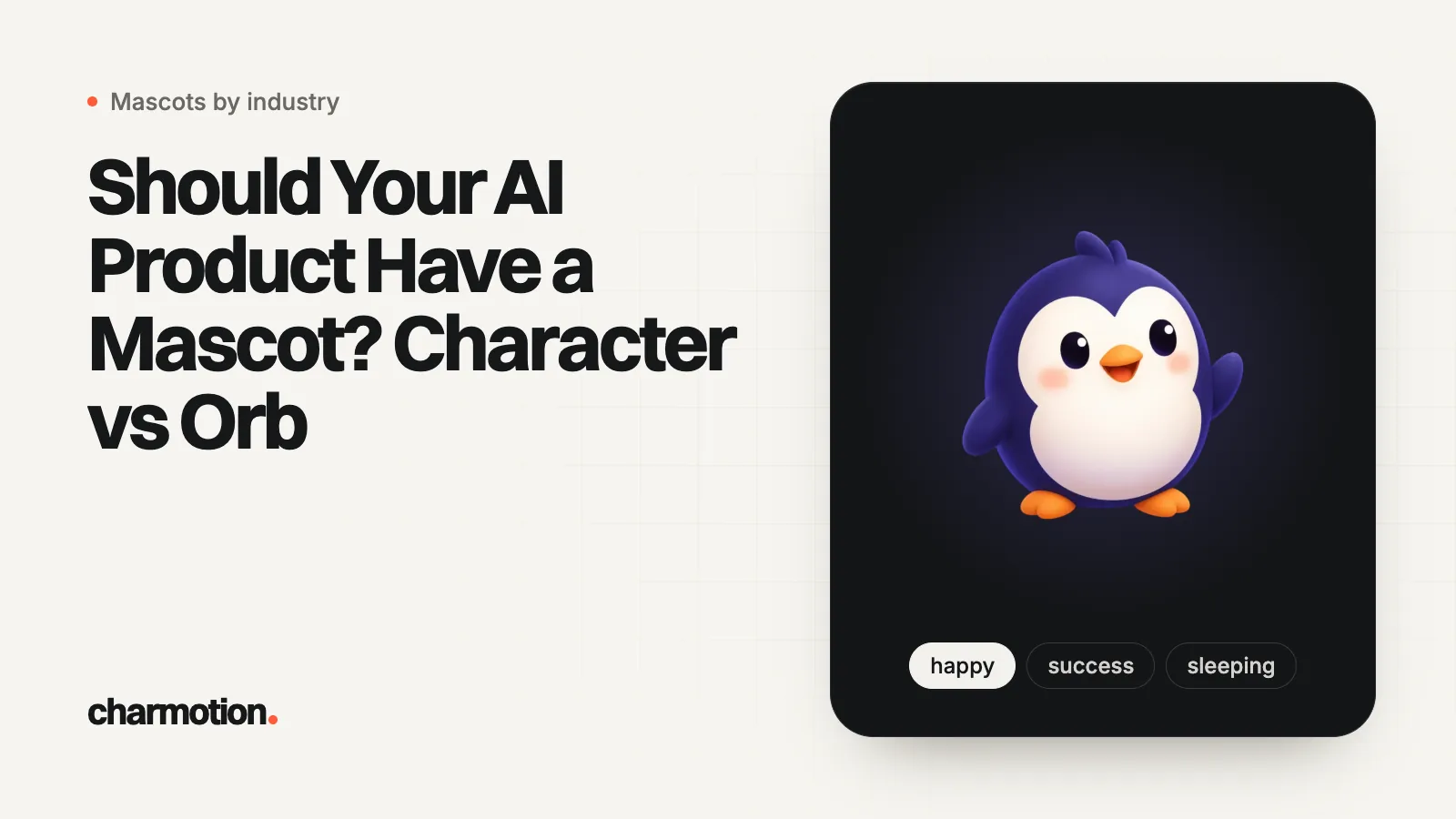
An AI product should have a mascot only if the character shows real system status and you can keep its personality in check. A character makes listening, working and answering easy to read and helps a young brand stand out; an abstract orb feels neutral and ages well. Either way, never imply feelings or abilities the product doesn't have.
Key takeaways
- Fast Company calls the rush to cute agent characters "cutewashing", citing OpenAI's dots, Meta's Muse and GrokBot.
- NN/g's "Humanizing AI Is a Trap" warns that human-like framing raises overtrust; label what the agent is doing in plain words.
- Four loops carry agent status: listening, thinking, loading and talking, plus success and error for task outcomes.
- Text agents don't need lip-sync; a talking loop gated by output is enough.
- Choose a mascot for recognition and status, not as a trust lever: trust comes from accuracy and clear limits.
Already have a character or logo? See your character in real app screens: splash, onboarding, loading and empty-state screens. It's free, runs in your browser and uploads nothing.
Should an AI product use a character or an abstract orb?
Both work. The choice is about brand, not capability.
| Character mascot | Abstract orb or shape | No visual | |
|---|---|---|---|
| Recognition | High; easy to remember and reuse in marketing | Medium; many orbs look alike | Low |
| Status legibility | High; listening and thinking poses read instantly | Medium; needs color or motion conventions | Text only |
| Risk of over-humanizing | Higher, especially with human features | Lower | Lowest |
| Fits serious B2B buyers | Depends on tone; test it | Usually | Always |
| Ages well | If the art style is simple | Yes | Yes |
A non-human character (a robot, animal, blob or object) is a middle path: recognizable, but less likely to be mistaken for a person. If you start with an orb from a component library and want to switch later, keep the state names the same; AI Elements Persona vs a custom Rive character shows how.
What is cutewashing, and does it matter for a startup?
In October 2026, Fast Company described a trend it called cutewashing: as the largest AI companies add agent features, they converge on friendly characters, with OpenAI's dots, Meta's Muse and SpaceXAI's GrokBot as examples. In the piece, Anthony Cappetta of the studio Super Okay says the style helps companies "signal compliance" with familiar digital norms, and researcher Joshua Paul Dale warns that "cute or not, AI agents can invade our privacy" (Fast Company).
For a startup, this has two consequences:
- Cute is no longer a differentiator. If your agent mascot looks like the big platforms' characters, it blends in. A distinctive silhouette and color matter more than cuteness.
- Cute invites suspicion when you ask for access. A mascot asking for inbox, calendar or payment permissions will be read as softening the request. On permission screens, show the scope in plain text and keep the character neutral or absent.
Does a friendly character make an AI product more trusted?
Not directly, and too much warmth can backfire.
- A 2025 experiment with chatbot avatars (n=160) found that more human-like avatars improved trust and user experience only indirectly, through perceived empathy (Frontiers).
- Nielsen Norman Group's "Humanizing AI Is a Trap" (January 2026) argues that personality features and emotional language raise the risk of overtrust and unrealistic expectations, and cites research that the more people attribute emotions to AI, the less willing they are to take its advice. It recommends "real tools, not fake friends", neutral system messages and avoiding human-like bot names (NN/g).
The practical reading: a mascot can carry the brand and make status visible, but trust has to come from accurate answers, clear limits and honest permission requests. Keep the character's job small, and let the product's text be precise.
Which states show that an agent is working?
Map real pipeline events to states, and label each one with what is actually happening. NN/g advises against vague "thinking" labels for processing delays, so the pose can be thinking while the text says "Reading 3 files" or "Searching the web".
| Agent event | State | Text beside it |
|---|---|---|
| User typing or speaking | listening (6) | None, or "Listening" |
| Request sent, model planning | thinking (3) | "Planning steps" |
| Tool calls, browsing, file processing | loading (5) | The current step, updated live |
| Output streaming | talking (7) | The answer itself |
| Needs approval or input | attention (9) | What it wants to do and why |
| Task finished | success, then idle (0) | A summary of what changed |
| Step failed | error, then idle (0) | What failed and the next option |
| Background or scheduled agent | sleeping (8) | Next run time |
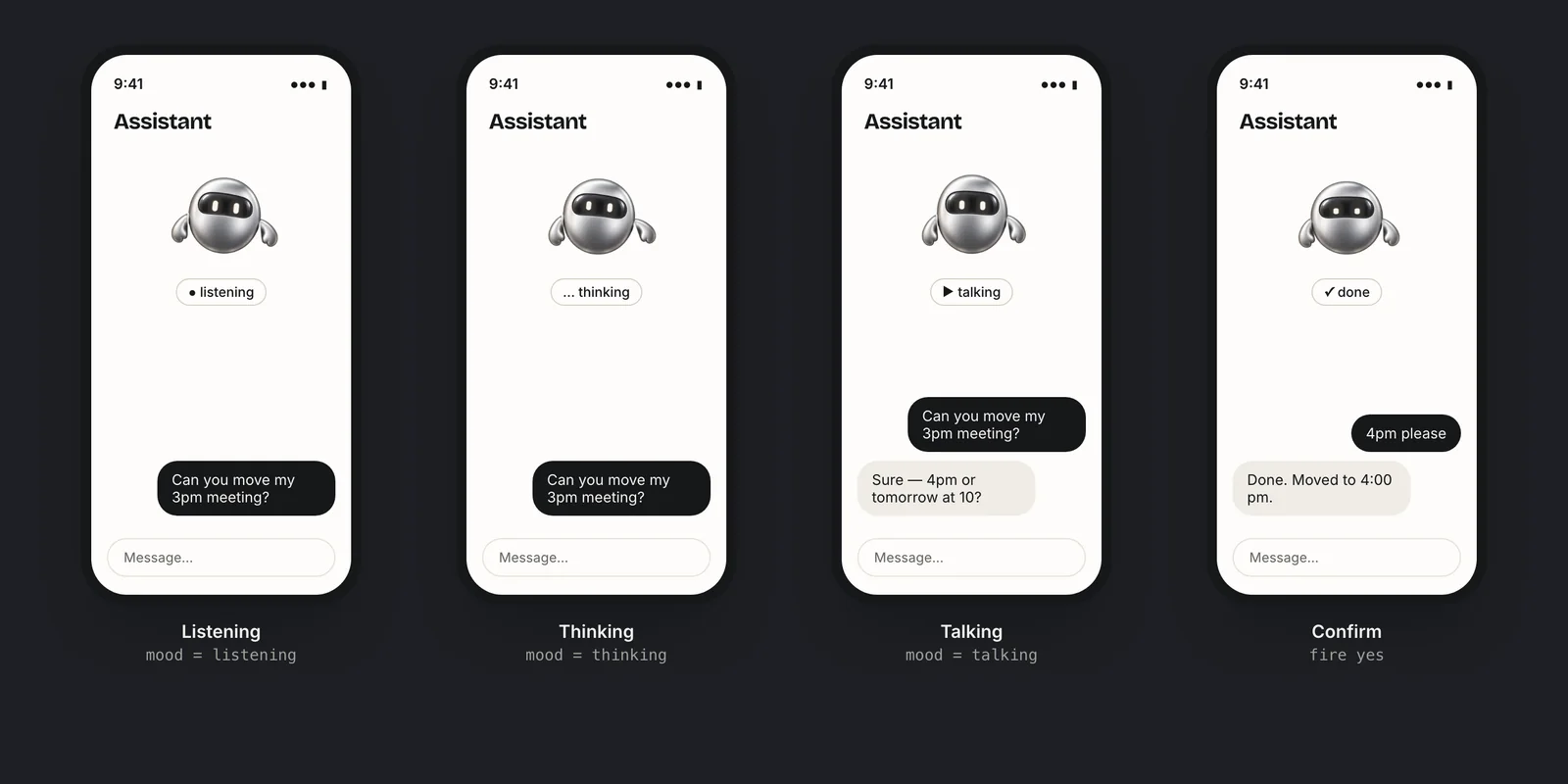
For long tasks the mascot is not a progress indicator. NN/g's response-time guidance puts about 10 seconds as the limit for keeping attention on a task; beyond that, people need to know how long it will take (NN/g). Show steps or a percentage next to the loop. Wiring these events in code is covered in AI assistant avatar animation and, for voice, voice agent avatars with OpenAI Realtime events.
Does an AI mascot need lip-sync?
For a text agent, no. A talking loop that plays while tokens stream, and stops when they stop, reads as "answering" without anyone checking mouth shapes.
For a voice product, a talking loop gated by audio playback is a reasonable start. Real lip-sync is a bigger project: Duolingo describes driving its characters' mouths with visemes, a set of mouth shapes matched to speech sounds, inside Rive state machines (Duolingo). That needs a rig built for it.
A mascot that doesn't pretend to speak also helps with the over-humanizing risk above. A robot or blob that pulses while it answers is honest about what it is.
Where should an AI startup's mascot show up?
- In the product: empty chat, agent status, task results, errors. Keep it small and beside the content.
- Launch: a 9:16 video for Reels, Shorts and TikTok, a GIF for Product Hunt, a looping hero on the landing page.
- Docs and changelog: a still or a short loop on the docs home, not on every page.
- Not on: permission requests, billing, data deletion, security notices.
Charmotion covers these from one image: 17 animations of the same character, including listening, thinking, loading, talking, success and error, as a .riv driven by a mood number and triggers, plus MP4, a 9:16 launch video and GIFs (paid plans, from $20/month). It does not make lip-sync, new poses such as typing on a laptop or holding tools, outfits, or a progress bar, so pair it with your own step list for long tasks.
Frequently asked questions
Is a cute AI mascot manipulative?
Not by itself, but it can be used manipulatively. Fast Company's cutewashing critique is about friendly characters softening requests for broad data access. Keep the mascot off permission, billing and privacy screens, state scopes in plain text, and never let the character's mood pressure users into agreeing.
Should an AI agent mascot have a human name?
Usually not. NN/g recommends avoiding human-like bot names because they push users to treat the tool as a person, which raises overtrust. A non-human character with a brand name, or a product name with no persona, keeps expectations closer to what the software can do.
Can a mascot replace a progress indicator for long agent tasks?
No. A looping character says something is happening, not how long it will take. NN/g puts about 10 seconds as the limit of attention, so for longer tasks show the current step or a percentage beside the loop and keep the mascot as a secondary signal.
Quick answers from this guide
Sources
- Big Tech is cutewashing its AI agents, Fast Company
- Humanizing AI Is a Trap, Nielsen Norman Group
- Anthropomorphism, empathy and trust in chatbot avatars (Ma et al., 2025), Frontiers in Computer Science
- Response Times: The 3 Important Limits, Nielsen Norman Group
- How Duolingo's characters lip sync (visemes), Duolingo Blog