Kids and Education App Mascots: Lessons From Duolingo
By the Charmotion team · Updated
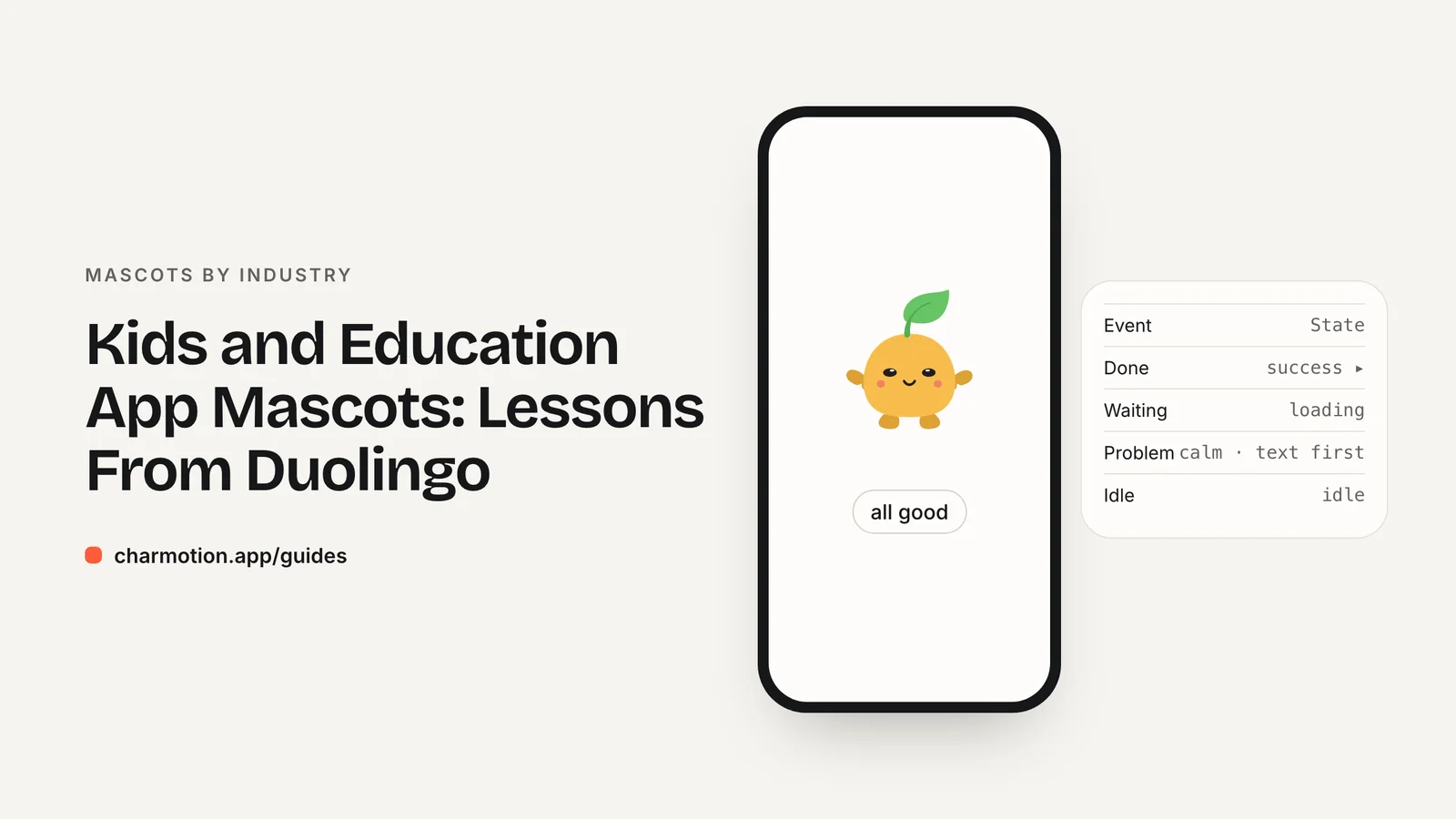
An education app mascot should react to learning, not pressure the learner. Use quick yes and no reactions for answers, a success reaction for finished lessons and calm loops while waiting. Never loop a sad face on mistakes or guilt users into returning. For children's apps, review COPPA and the UK Children's Code before the mascot collects voice or photos.
Key takeaways
- Duolingo uses Rive state machines for its World Characters' lip sync across 40+ languages and 100+ courses.
- Duolingo reports a streak animation raised new-learner day-7 retention by 1.7%; its 3.6x course-completion figure is correlational.
- Celebrate correct answers more than you react to wrong ones, and return to neutral fast after a mistake.
- The amended COPPA Rule took effect June 23, 2025, with most compliance due April 22, 2026.
- Guilt-trip reminders are confirmshaming; the UK Children's Code warns against exploiting children's need for approval.
Already have a character or logo? Preview your own character animated in a phone splash, a website hero and an empty state — free, in your browser, nothing uploaded.
How does Duolingo animate its characters?
Duolingo is the best-documented case of mascot animation in a learning app. Its engineering blog describes using Rive for lip sync on its ten World Characters, with more than 20 mouth shapes, across 40+ languages and 100+ courses. The team chose Rive partly because file sizes were compact, and because the state machine lets developers programmatically control which animation states are called (Duolingo blog).
Rive later described Duolingo's Video Call feature, where the character Lily combines 8 head and 8 body animations into more than 64 idle variations while the file stays under 1 MB (Rive blog). That is Rive's own account of a customer project.
The lesson for smaller apps is the architecture, not the scale. A single interactive file with a state machine lets one character react to many events without a separate video per moment. Your lesson code sets a state, and the file handles the transitions.
For a general introduction to that pattern, see mascot animation states and how to make an animated app mascot.
Do streak and celebration animations help learning apps?
Duolingo has published two numbers that are often quoted, and they mean different things (Duolingo blog):
- Learners who reach a 7-day streak are 3.6 times more likely to complete their course. This is a correlation. Motivated learners both keep streaks and finish courses; the streak does not necessarily cause completion.
- A new streak animation increased the likelihood that a brand-new learner was still using the app 7 days later by 1.7%. This is an A/B result for one animation, reported by the company.
Both are Duolingo's own figures from a product with a very large audience. They support the idea that well-placed celebration can matter, not that any celebration will.
The design takeaway is to put the biggest reaction on the moment that matters most for the habit, such as finishing a lesson or extending a streak, and keep everything else small. If every tap triggers a party, the important moments stop standing out.
Which mascot states does a lesson flow need?
A lesson flow is a sequence of short events, which suits a mix of loops and one-shots:
| Event | State | Loop or one-shot | Notes |
|---|---|---|---|
| Lesson starts | enter, then idle (0) | One-shot, then loop | Keep the entrance under a second or two |
| Question shown | listening (6) or thinking (3) | Loop | Subtle; the question is the focus |
| Correct answer | yes, then happy (1) briefly | One-shot | Return to idle before the next question |
| Wrong answer | no, then idle (0) | One-shot | Never loop sad (4) on repeated mistakes |
| Lesson complete | success | One-shot | The biggest reaction in the flow |
| Read-aloud or tutor speech | talking (7) | Loop | Only while audio plays |
| Inactive or paused | sleeping (8) | Loop | Calm, low motion |
| Reminder or return screen | wave (2) | Loop | No guilt copy |
The asymmetry matters: correct answers get a visible reward, wrong answers get a quick, neutral acknowledgment. A learner who gets three wrong in a row should not watch the mascot become progressively more upset.
How do I celebrate without manipulating kids?
Children respond strongly to approval from characters, which is exactly why it must not be used against them. The UK Information Commissioner's Office Children's Code (standard 13) says not to use nudge techniques to lead children to provide unnecessary personal data or turn off privacy protections, and warns against exploiting their need for affirmation. The same standard encourages nudges toward wellbeing, such as taking breaks (ICO).
In practice:
- Celebrate learning, not data. Never reward a child for enabling the microphone, adding a photo, inviting friends or accepting tracking.
- Keep the mascot off consent and privacy screens. No happy or attention loop next to a "Turn on" button.
- Use the mascot for breaks. A sleeping or wave state that suggests stopping after a session is a positive nudge.
- Tie rewards to effort. A success reaction for finishing a lesson is fine. A reaction designed to keep a child tapping past the end of the lesson is not.
These are good rules for adult learning apps too.
What do COPPA and the UK Children's Code mean for mascot design?
Mascots themselves are not regulated, but what they collect is. In the United States, the FTC's amended COPPA Rule took effect June 23, 2025, and most obligations had to be met by April 22, 2026. The amendments include separate verifiable parental consent before disclosing children's data to third parties, biometric identifiers added to the definition of personal information, and a requirement for a written data retention policy (Federal Register).
That matters for mascot features that seem harmless:
- A mascot that "listens" to a child reading aloud collects voice data.
- A mascot that reacts to a child's face through the camera may involve biometric data.
- A third-party analytics or AI service behind the mascot may count as a disclosure to a third party.
In the UK, the Children's Code adds the nudge rules described above. If your app serves children, run any mascot feature that uses the microphone, camera or an external service through your privacy review. This guide is design guidance, not legal advice.
A mascot that only plays pre-made animations in response to taps and answers collects nothing by itself. That is the simplest design to keep compliant.
How do I avoid guilt-trip reminders?
Reminder and cancellation screens are where mascots most often cross the line. Confirmshaming is a recognized deceptive pattern in which users are emotionally manipulated into doing something they would not otherwise have done (Deceptive Patterns). A crying mascot with copy like "You're leaving me?" is a textbook example.
Safer patterns:
- Reminder notifications: a friendly wave and a neutral line such as "Ready for today's lesson?"
- Missed day: idle or wave, with copy that welcomes the user back rather than counting losses.
- Turning off reminders or unsubscribing: idle or exit, with a plain confirmation. No sad state.
- Streak broken: acknowledge it in text, and show the next achievable goal.
The sad loop can stay in your file for playful in-lesson moments, but keep it away from any screen where the user is deciding whether to continue, pay or share.
How do I add reduced-motion and pause controls?
Learning screens combine motion with reading, which is exactly the situation WCAG 2.2.2 addresses. Moving content that starts automatically, lasts more than five seconds and appears alongside other content needs a way to pause, stop or hide it (W3C). A mascot looping next to a reading exercise qualifies.
- Honor system settings. On the web,
prefers-reduced-motionreports when the user has asked to minimize non-essential motion (MDN); native platforms have equivalents. Show a static pose instead. - Add an in-app switch. Children rarely change OS settings. A visible "calm mode" toggle, ideally in a parent area, covers them.
- Let loops settle. After a reaction, return to a low-motion idle or sleeping state rather than continuous bouncing.
- Keep feedback textual too. "Correct!" or "Try again" must appear in text, so the lesson works with motion off.
Charmotion's set includes the states this guide uses (yes, no, success, happy, listening, talking, sleeping, wave) in one .riv, plus MP4 and GIF for store previews. A rounded character like Pip, from Charmotion's demo set, shows the friendlier end suited to younger audiences.
Frequently asked questions
How should a kids' app mascot react to wrong answers?
Briefly and without shame. Play a quick no reaction, then return to neutral idle, and never loop a sad face on repeated mistakes. Celebrate correct answers more visibly than you react to errors, and make sure the feedback also appears as text so it works with motion turned off.
Does Duolingo's streak animation really improve retention?
Duolingo reports that a new streak animation raised the share of brand-new learners still active after 7 days by 1.7%. That is the company's own A/B result. Its separate claim that 7-day-streak learners are 3.6 times likelier to finish a course is a correlation.
Does COPPA apply to an app mascot?
COPPA applies to the data your app collects from children under 13, including through a mascot. If the character uses the microphone, camera or a third-party service, it falls under the amended rule, effective June 23, 2025, with compliance due April 22, 2026. Consult counsel for specifics.
Is a sad mascot on a reminder screen a dark pattern?
It can be. Guilt-tripping users into returning or staying subscribed is confirmshaming, a recognized deceptive pattern. Use a neutral wave or idle state and welcoming copy instead. In children's apps, the UK Children's Code also warns against exploiting a child's need for approval.
Quick answers from this guide
Sources
- How Duolingo's characters lip sync (visemes) — Duolingo Blog
- Duolingo's AI-powered Video Call brings Lily to life — Rive Blog
- How Duolingo's streak builds habit — Duolingo Blog
- Children's Online Privacy Protection Rule (final rule amendments) — Federal Register (FTC)
- Age appropriate design code: 13. Nudge techniques — Information Commissioner's Office (UK)
- Confirmshaming — Deceptive Patterns
- Understanding SC 2.2.2: Pause, Stop, Hide — W3C WAI
- prefers-reduced-motion — MDN Web Docs