Fitness Coach Mascots: Streaks, Cheers and Haptics
By the Charmotion team · Updated
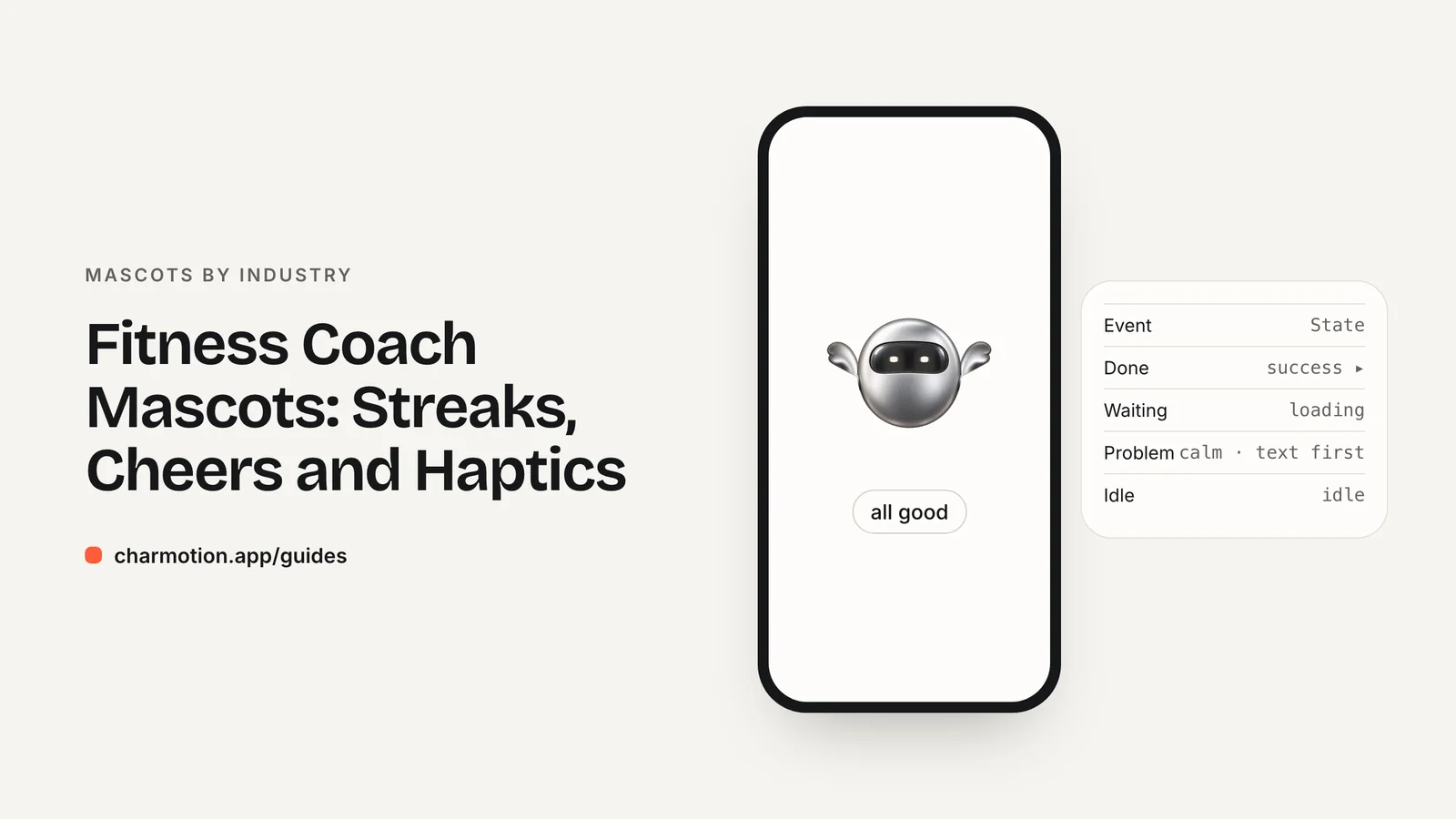
A fitness app mascot should celebrate in proportion: a small yes reaction per set, a success reaction with a success haptic at the end of a workout, and a bigger celebration only for streak milestones. On missed days and rest days, it should stay encouraging and calm. Never guilt users, and never celebrate through an injury or pain warning.
Key takeaways
- Duolingo reports a streak animation raised new-learner day-7 retention by 1.7%, its own A/B result.
- Scale celebrations to the achievement so milestones still stand out after weeks of use.
- Missed days get encouraging idle or wave states, not sad faces or guilt copy.
- Apple's haptics guidance favors consistent, complementary feedback and warns against overuse.
- Celebration loops must stop on their own or be pausable under WCAG 2.2.2.
Already have a character or logo? Preview your own character animated in a phone splash, a website hero and an empty state — free, in your browser, nothing uploaded.
Do streaks and celebrations improve retention?
There is company evidence that celebration animation can matter. Duolingo reported that a new streak animation increased the likelihood that a brand-new learner was still using the app seven days later by 1.7% (Duolingo blog). That is a learning app, not a fitness app, and it is the company's own A/B result, but streak mechanics work the same way in habit products.
Duolingo also reports that learners who reach a 7-day streak are 3.6 times more likely to complete a course. Treat that as a correlation: committed people both keep streaks and finish things. Do not use it to argue that streaks cause results.
Two practical conclusions:
- The moment a streak is extended is worth a well-designed reaction, because that is where the habit is being reinforced.
- One good animation on the right moment can measurably matter, which also means you should A/B test it rather than assume.
For a broader look at evidence for mascots, see should your app have a mascot.
Which moments deserve a full celebration and which a nod?
A celebration scale keeps rewards meaningful. Map each moment once and stick to it:
| Event | State | Loop or one-shot | Haptic (iOS) | Notes |
|---|---|---|---|---|
| Workout starts | attention (9), then idle | Loop | Light impact | Settle quickly; the timer is the focus |
| Set or interval done | yes | One-shot | None or light | Small and fast |
| Coaching cue or audio guidance | talking (7) | Loop | None | Only while audio plays |
| Workout complete | success, then happy (1) | One-shot, then loop | Success notification | Summary stats in text |
| Streak milestone (for example, 7 or 30 days) | success, then wave (2) | One-shot, then loop | Success notification | The biggest moment; keep it rare |
| Personal record | success | One-shot | Success notification | Name the record in text |
| Missed day | idle (0) or wave (2) | Loop | None | Encouraging copy, no guilt |
| Rest day | sleeping (8) | Loop | None | Rest is part of the plan |
| Pain or injury warning | No mascot, or static | — | None | Plain text only |
The scale has three levels: a nod (yes), a reward (success), and a milestone (success plus a follow-up loop). If routine completions get the milestone treatment, nothing feels special by week three.
How should a coach mascot react to a missed day?
With encouragement, not disappointment. A user who missed a workout is at the exact point where the habit is most likely to break. Guilt is a poor motivator here and a well-known deceptive pattern elsewhere: confirmshaming manipulates users with guilt into doing something they would not otherwise have done (Deceptive Patterns).
Good missed-day patterns:
- Neutral state. Idle or wave, never sad.
- Forward-looking copy. "Ready to pick it back up?" rather than "You broke your streak."
- A smaller next step. Offer a short session to restart momentum.
- Honest streak status. Show the streak count plainly; do not hide it, but do not dramatize the loss.
Notifications follow the same rule. A reminder can include a friendly wave image, but it should not show a crying or sulking character. If users turn reminders off, confirm with a neutral state and move on.
How do I sync haptics with mascot triggers?
Haptics and animation should tell the same story at the same moment. Apple's guidance on playing haptics recommends using them consistently, pairing them with visual or audio feedback, and not overusing them; the system's notification haptics cover success, warning and error (Apple HIG).
In practice, fire the haptic in the same function that fires the mascot trigger, so they cannot drift apart:
func workoutCompleted() {
    mascot.triggerInput("success")
    UINotificationFeedbackGenerator().notificationOccurred(.success)
    mascot.setInput("mood", value: 1.0) // happy
}

func setCompleted() {
    mascot.triggerInput("yes")
    // no haptic, or a light impact
}
Rules of thumb:
- Use the success haptic only with the success reaction, so the pairing stays meaningful.
- Skip haptics for per-set nods if sets are frequent; constant buzzing becomes noise.
- Do not use the error haptic for missed days or rest. Nothing failed.
- Respect the user's system haptics settings; the system generators already do.
How do I avoid over-celebrating?
Over-celebration has two costs. Rewards lose meaning when they are constant, and continuous motion becomes a distraction during the workout itself.
- Keep one-shots short. A celebration should finish in a couple of seconds and return to a calm loop.
- Settle loops. After a success, play happy briefly, then return to idle rather than looping excitement indefinitely.
- Do not animate during effort. While the user is mid-set, keep the mascot still or in a subtle idle. The timer and rep count need the screen.
- Vary only at milestones. If you want variety, add it to rare moments, not routine ones.
- Offer a quiet mode. Some users want the data without the character; let them turn it off.
Accessibility rules reinforce this. Under WCAG 2.2.2, moving content that starts automatically, lasts more than five seconds and runs alongside other content needs a pause, stop or hide control (W3C). A happy loop next to workout stats qualifies. With prefers-reduced-motion or the native equivalent on, show a static pose (MDN).
Which states map to rest days and recovery?
Rest days are part of training, so the mascot should treat them as a normal, positive state rather than an absence.
- Scheduled rest: sleeping is a natural fit, with copy like "Rest day. Recovery counts."
- Recovery content (stretching, mobility): idle or listening, with low motion.
- Pain, injury or overtraining warnings: no mascot, or a static pose. This is the one place a fitness mascot should never cheer, even if the user is mid-streak.
- Returning after a break: enter, then wave, to welcome the user back without commentary on the gap.
Charmotion's standard set covers this whole guide from one upload: loops for idle, happy, wave, thinking, sad, loading, listening, talking, sleeping and attention (selected by a mood number 0–9), one-shot success, error, yes, no, enter and exit triggers, and a launch intro, delivered in about 1–2 hours as one .riv plus MP4, 9:16 MP4 for social clips, GIF and transparent video. Pip, the fruit character from Charmotion's demo set, is shown in the clips above.
How to set up celebration states for a fitness app mascot
- Define three celebration levels. Assign a nod (yes) to sets, a reward (success) to finished workouts, and a milestone (success plus a loop) to streak goals and records.
- Map calm states. Use idle or wave for missed days, sleeping for rest days, and no mascot on pain or injury warnings.
- Pair haptics in code. Fire the success haptic in the same function as the success trigger, and skip haptics on frequent nods.
- Settle every loop. Return to idle after celebrations and keep the mascot still while the user is mid-set.
- Add motion controls. Respect reduced-motion settings with static poses and give long loops a pause control or a quiet mode.
Frequently asked questions
Should fitness app mascots celebrate every workout?
Celebrate milestones fully and routine completions lightly. A small yes reaction per set, a success reaction with a success haptic at workout end, and a bigger celebration only for streak milestones keeps rewards meaningful. Duolingo's streak animation result shows the right moment matters most.
What should a fitness mascot do when a user misses a day?
Stay encouraging. Use an idle or wave state with forward-looking copy such as a short restart session, never a sad face or guilt message. Guilt-based nudges are a form of confirmshaming and tend to push users away at the moment the habit is most fragile.
Should haptics play with every mascot reaction?
No. Apple's guidance favors consistent haptics paired with visual feedback and warns against overuse. Reserve the success haptic for the success reaction at workout end or milestones, and skip haptics for frequent per-set reactions so the feedback stays meaningful and noticeable.
Quick answers from this guide
Sources
- How Duolingo's streak builds habit — Duolingo Blog
- Playing haptics — Apple Human Interface Guidelines
- Confirmshaming — Deceptive Patterns
- Understanding SC 2.2.2: Pause, Stop, Hide — W3C WAI
- prefers-reduced-motion — MDN Web Docs