Rive vs Spline: 2D Interactive vs 3D Scenes
By the Charmotion team · Updated
Choose Rive for interactive 2D vector characters and UI, and Spline for real-time 3D scenes. Rive exports a compact .riv file with a state machine that native runtimes and the web play. Spline exports 3D scenes as web code, native Swift and Kotlin embeds, or video. If you only need the look of 3D, rendered video can be simpler.
Key takeaways
- Spline is a 3D design tool; Rive is a 2D vector animation tool with a state machine in the file.
- Spline exports code for Vanilla JS, Three.js, React, Next.js and react-three-fiber, but animations and events only in Vanilla JS and React.
- Rive ships one .riv to official web, Apple, Android, Flutter and React Native runtimes.
- No neutral benchmark compares them; measure on your target devices.
Is Spline a 3D Rive?
Not quite. Both are browser-based design tools that produce interactive content for websites and apps, which is why they get compared. Underneath, they solve different problems.
Spline builds real-time 3D scenes: meshes, materials, lights and cameras that the viewer can rotate and interact with. Rive builds 2D vector animation: shapes, bones and timelines, wired into a state machine that your code drives.
| Rive | Spline | |
|---|---|---|
| Dimension | 2D vector (bones and meshes can fake depth) | Real-time 3D |
| Output | Binary .riv file | Hosted scene, code export, native embed or video |
| Runtimes | Web (JS, React), Apple, Android, Flutter, React Native | Web (Vanilla JS, Three.js, React, Next.js, react-three-fiber); native Swift and Kotlin embeds |
| Interactivity | State machine; data binding (legacy inputs still work) | Object states and events; animations and events in Vanilla JS and React exports |
| Video export | Paid Rive plans: H.264, GIF, WebM, image sequences | WebM, MP4, image sequence (per Spline's FAQ) |
| Typical asset | Mascots, icons, interactive UI controls | 3D product shots, hero scenes, spatial UI |
If your artwork needs to be orbited, lit or viewed from any angle, you need 3D. If it is a character or control seen from the front, 2D is lighter and easier to drive from code.
What can each export?
Spline documents code export for Vanilla JS, Three.js, React, Next.js and react-three-fiber. Its docs add an important limit: animations and events are only enabled when exporting to Vanilla JS and React. The other targets give you the scene for your own Three.js code to animate. Spline's FAQ also describes native Swift (Apple) and Kotlin (Android) embeds, self-hosted ZIP exports, and video export as WebM, MP4 or an image sequence. We could verify the code-export page directly; treat the native and video details as Spline's own description and check them against the current docs before you plan around them.
The React route uses Spline's @splinetool/react-spline package, which loads a scene URL into a canvas and exposes the loaded application object for code to find objects and emit events.
Rive exports a .riv file. Official runtimes play it on the web, in React, on Apple platforms, Android, Flutter and React Native. The runtimes are MIT-licensed; the editor's free plan exports files that play a Rive splash screen. Rive's own video and image exports (H.264, GIF, PNG and SVG sequences, WebM) are available on paid plans only.
The practical difference: Spline's output is tied to a 3D scene loader on each platform, while Rive's is one small file played by a dedicated 2D runtime.
Which is lighter on mobile?
There is no neutral benchmark comparing the two, so be wary of anyone who quotes one number. What can be said with sources:
- Rive publishes its runtime sizes. On iOS it adds about 1.67 MB to download size and 4.66 MB installed; on Android arm64 about 2.40 MB download and 7.03 MB installed. On the web, its packages are 222–648 KB brotli-compressed. These are vendor figures. The .riv files themselves are typically small for flat art.
- Spline does not publish a comparable runtime-size table that we could find. A 3D scene's cost depends heavily on mesh count, texture sizes, lighting and post-processing, all of which you control in the editor.
As a general rule, rendering a lit 3D scene asks more of the GPU than drawing flat vector shapes, but a lean 3D scene can beat a bloated 2D file. Test on a mid-range Android phone, not just a recent iPhone, and watch frame rate, memory and battery during a few minutes of interaction.
Whatever you choose, avoid starting either runtime on pages that do not show the asset, and pause rendering when it scrolls out of view.
Which has a real state machine?
Rive does, as a core part of its format. A Rive state machine holds the loops and one-shot reactions of a character, the transitions and blends between them, and pointer listeners on parts of the artwork. Your app changes properties and the file decides what to play. Rive's docs now recommend data binding with view models for that control, calling state-machine inputs legacy while keeping them working. Data binding syncs values both ways between app and file.
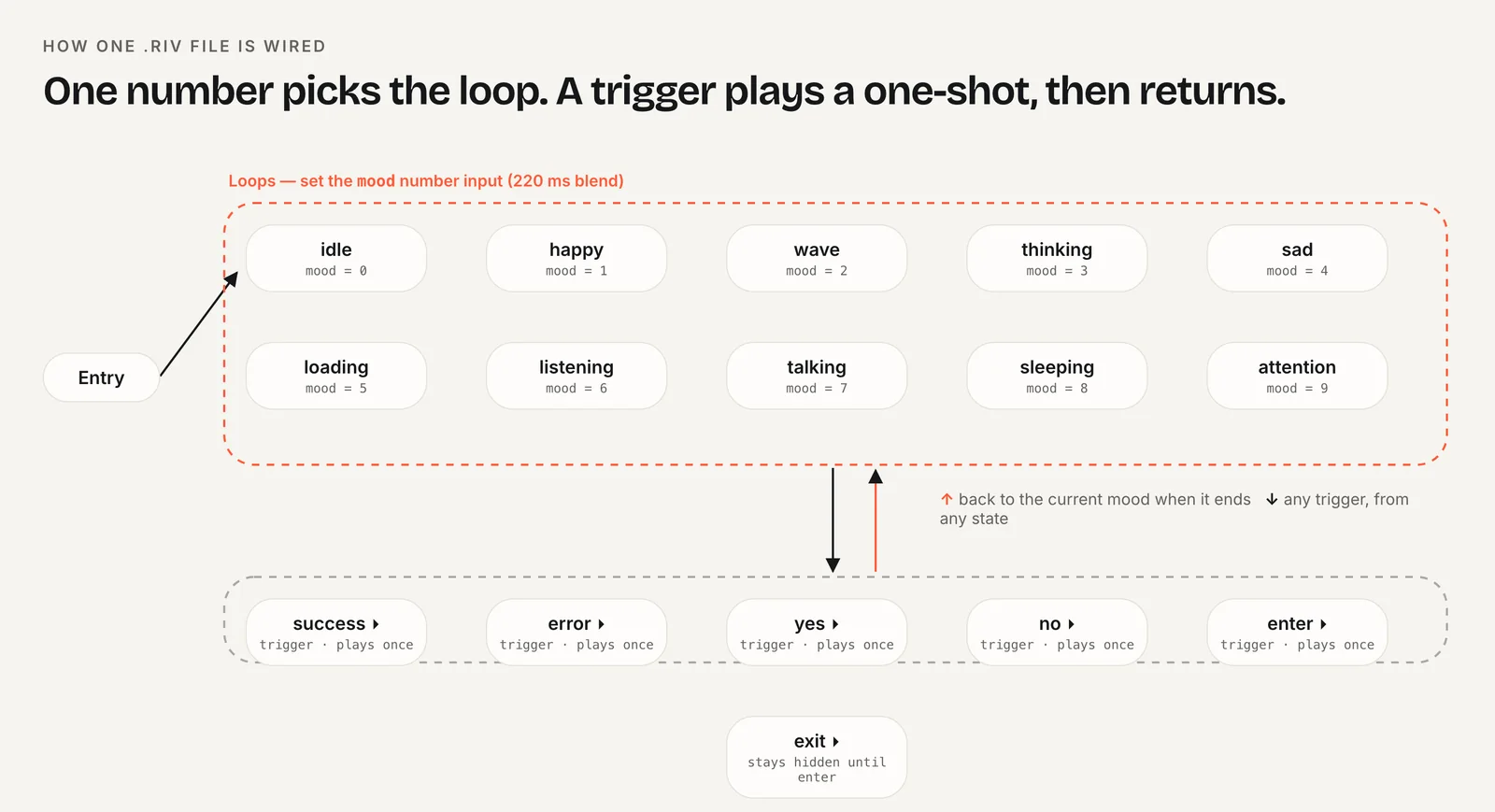
Spline handles interactivity through object states and events: an object can move between states in response to events such as hover, click or key presses. In exported code, the runtime lets you look up objects by name and emit events on them, which is enough for many hero scenes and product configurators. It is organized around objects in a scene rather than around one named state machine that app code drives through typed properties.
So the question is what you are building. A character that must reflect app state such as loading, success and error maps directly onto a Rive state machine. A 3D object that reacts to the cursor maps naturally onto Spline's events.
Can a 2D mascot fake depth in Rive?
Often well enough. Rive's bones and mesh deformation let an animator squash, stretch, bend and turn artwork slightly, so a character can tilt its head, lean in or bounce with a convincing sense of volume. Layered parts moving at different speeds add parallax. What 2D cannot do is reveal sides of an object that were never drawn: a full turnaround needs either many drawings or real 3D.
A practical middle path is to render a 3D-looking character or logo once, as an image, and animate that image in 2D. The volume and lighting come from the render; the motion comes from the rig.
That is how Charmotion's motion mode works on 3D-rendered logos: the original pixels are bent by a bone rig inside a Rive file. You upload a character, mascot or logo and get 17 animations in about 1–2 hours as one .riv, plus MP4, GIF and transparent WebM and MOV. It is not a substitute for Spline when a viewer must orbit the object; it is a lighter option when you only need 3D-looking art to react to app state.
When should you pick video instead?
When the animation does not need to react to anything. A product rotating in a hero, a launch reveal or a looping brand scene looks the same whether it is computed live or played back. Rendered as video, it needs no 3D runtime, behaves predictably on every device, and can be optimized like any other media file.
Both tools can produce video: Spline's FAQ lists WebM, MP4 and image-sequence export, and Rive's paid plans export H.264, GIF, WebM and image sequences. For a transparent overlay on a website, you need two encodes, an HEVC-with-alpha .mov for Safari and a VP9 WebM for other browsers; Transparent Video on Websites has the markup and settings.
Keep the live version when the viewer must interact: drag to rotate, configure colors, or see a character change state. Otherwise video is usually the cheaper and more robust choice. GIF vs WebM vs MP4 vs Lottie vs Rive compares the file formats directly.
Should you choose Rive or Spline?
Choose Rive if:
- you are animating a 2D character, mascot, icon or interactive control;
- it has several states that app code switches between;
- it must play natively in iOS, Android, Flutter or React Native apps from one file;
- file size and runtime predictability matter more than true depth.
Choose Spline if:
- the content is genuinely 3D: products, environments, objects viewers rotate;
- you want lighting, materials and camera moves that 2D cannot fake;
- your main target is the web, ideally with the Vanilla JS or React export so animations and events survive;
- a 3D designer owns the asset.
Choose video if it only needs to play. Some teams combine all three: a Spline hero on the landing page, a Rive mascot in the app, and video for social posts.
Frequently asked questions
Can Spline export to React?
Yes. Spline's docs list code export for React, Next.js, react-three-fiber, Three.js and Vanilla JS. Animations and events are only enabled in the Vanilla JS and React exports, so pick one of those if the scene should stay interactive. The React package loads the scene into a canvas component.
Can Rive do 3D?
Rive is a 2D vector tool. Bones, mesh deformation and layered parallax can give characters a convincing sense of volume, and you can animate a 3D-rendered image, but a Rive file cannot show sides of an object that were never drawn. For true 3D scenes, use a 3D tool such as Spline.
Does Spline work in native mobile apps?
Spline's FAQ describes native embeds for Apple platforms in Swift and for Android in Kotlin, alongside web code export. Check the current documentation for supported features on each platform before committing, and test performance on mid-range Android hardware, since 3D scenes vary widely in GPU cost.
Is Rive or Spline better for a website hero?
Use Spline when the hero is a 3D object visitors can rotate or explore. Use Rive for a 2D mascot or illustrated scene that reacts to the cursor or page state. If the hero only needs to play, a rendered video is often lighter and more reliable than either runtime.
Quick answers from this guide
Sources
- Exporting as code — Spline
- FAQ — Spline
- react-spline — Spline on GitHub
- Runtime sizes — Rive
- Data binding overview — Rive
- State machine inputs (legacy) — Rive
- Exporting for video and static design — Rive
- Pricing — Rive