Rive Alternatives: Lottie, Spline, Motion and More
By the Charmotion team · Updated
The main Rive alternatives are Lottie with dotLottie state machines for After Effects teams, Spline for interactive 3D, Motion for code-driven UI animation in React and JavaScript, your game engine's own animation system, and plain video when nothing needs to be interactive. Each covers part of what Rive does; none is a drop-in replacement.
Key takeaways
- Lottie is the closest alternative now that Lottie Creator has state machines (September 2025), but its logic model is simpler than Rive's.
- Spline is for 3D scenes; Motion animates your own UI code. Both solve different problems from Rive.
- Many teams look elsewhere because of Rive's paid video export and the free plan's splash screen, not the runtime.
- If you only need rendered clips, video files avoid any runtime at all.
Why do people look for a Rive alternative?
The reasons are usually practical rather than technical:
- Editor pricing and exports. As of October 2026, Rive's Free plan costs $0 but exported .riv files play a Rive splash screen, and video export (MP4, GIF, PNG sequence, WebM) is limited to paid plans. Paid seats start at $9 per seat per month on Cadet (up to three seats), then $32 on Voyager and $120 on Enterprise. Check the pricing page, because plans change.
- A new tool to learn. Rive has its own editor, rigging and state machine graph. After Effects skills transfer only partly.
- Runtime weight on the web. Rive lists its web WASM runtimes at 222–648 KB brotli-compressed, depending on the package. That is more than lottie-web or CSS.
- Wrong dimension. Rive is a 2D tool. Teams that need true 3D look elsewhere.
- API churn. Rive is moving from state machine inputs to data binding, and its React Native runtime was rewritten. Both are improvements, but they mean migration work.
Rive's runtimes themselves are MIT-licensed and free. Most of the friction sits in authoring, not playback, which matters when choosing an alternative: sometimes the answer is a different way to make .riv files rather than a different format.
How do the main Rive alternatives compare?
| Tool | 2D/3D | Output | Interactivity model | Free tier (Oct 2026) | Typical job |
|---|---|---|---|---|---|
| Rive | 2D | .riv; video on paid plans | State machines, data binding | Yes, with splash on exports | Interactive characters, controls |
| Lottie / dotLottie | 2D | .json, .lottie | dotLottie state machines | Players free; Creator from $19.99/mo billed annually | After Effects motion, icons |
| Spline | 3D | Web code exports, video | Events and states in scenes | Check Spline's pricing | 3D scenes and objects |
| Motion | 2D (DOM) | Your own components | Code | Open-source library | UI transitions and gestures |
| Game engine animation | 2D/3D | Engine-native | Engine animation graphs | Varies by engine | In-game characters |
| Video (MP4, WebM, MOV) | Any | Video files | Play and pause | Many free tools | Marketing clips, social |
| Charmotion | 2D from your image | .riv plus MP4, GIF, WebM, MOV | Rive data binding and inputs | No; from $4.99/mo | Character, mascot and logo sets |
LottieFiles lists Individual at $19.99 and Team at $24.99 per month, billed annually; we could not verify its free-tier limits or whether state machines need a paid plan, so check before you commit.
Is Lottie with dotLottie state machines enough now?
For many projects, yes. LottieFiles added visual state machines to Lottie Creator on September 23, 2025. The dotLottie specification supports numeric, string, boolean and event inputs; pointer interactions such as enter, exit, down, up and click; completion events; guards on transitions; tweened transitions with cubic-bezier easing; and actions such as setting a theme or opening a URL. That covers hover and click states, toggles and simple multi-step flows.
What Rive still does that dotLottie's specification does not describe: blend states that mix several animations by a value, two-way data binding through view models with types such as colors, enums and lists, and bone rigging with mesh deformation built into the same editor. LottieFiles calls its state machines "nearly as capable as Rive's"; that is LottieFiles' own assessment.
There is a player caveat too. State machines run only in dotLottie players. The classic lottie-web player plays JSON without them, so moving to interactive Lottie usually means changing your player as well.
Choose Lottie when your team lives in After Effects and the interactivity is modest. See Lottie vs Rive state machines for a capability-by-capability table.
When is Spline the better pick?
When the thing you are animating is genuinely three-dimensional and should be viewed from different angles, lit, or orbited by the user. Spline is a browser-based 3D design tool. Its docs list code exports for vanilla JavaScript, Three.js, React, Next.js and react-three-fiber, and note that animations and events are enabled only in the vanilla JavaScript and React exports. Spline's FAQ also describes video export.
Rive is the better pick when the art is flat or illustrated, when it must stay small, or when many instances appear at once, such as avatars in a list. 2D vector playback is lighter work than rendering a 3D scene, and a .riv for a flat character is typically tens of kilobytes.
There is also a middle path. A 3D-looking character can be rendered as images and animated in 2D, or rendered to video. You lose camera freedom but keep the look at a lower runtime cost. See Rive vs Spline for a direct comparison.
Is Motion (Framer Motion) an alternative or a complement?
Mostly a complement. Motion, the library formerly called Framer Motion, became independent in November 2024 and now offers React and plain JavaScript APIs. It animates your own DOM elements and components in code: layout changes, presence transitions, gestures, scroll effects. It doesn't play designer-made assets.
Rive does the opposite. It plays a vector file that a designer built, with its own internal logic, inside a canvas. You can't tell Motion to "make the mascot look worried"; you can tell a Rive state machine to switch to a worried loop.
Plenty of sites use both: Motion slides a card into view and a Rive character inside the card reacts to what the user does. If your animation needs are purely UI transitions, Motion (or CSS) can replace Rive entirely. If you have an illustrated character, it can't. See Rive vs Motion for more.
Should games use their engine's animation instead, and what if you just need video?
Games. If the animation lives inside a game, start with your engine's own animation system. It already integrates with physics, input and the render pipeline, and your team knows its tools. Rive can make sense for 2D UI overlays and menus inside a game, but check Rive's feature-support page for your engine and target platforms before assuming parity with its web and mobile runtimes.
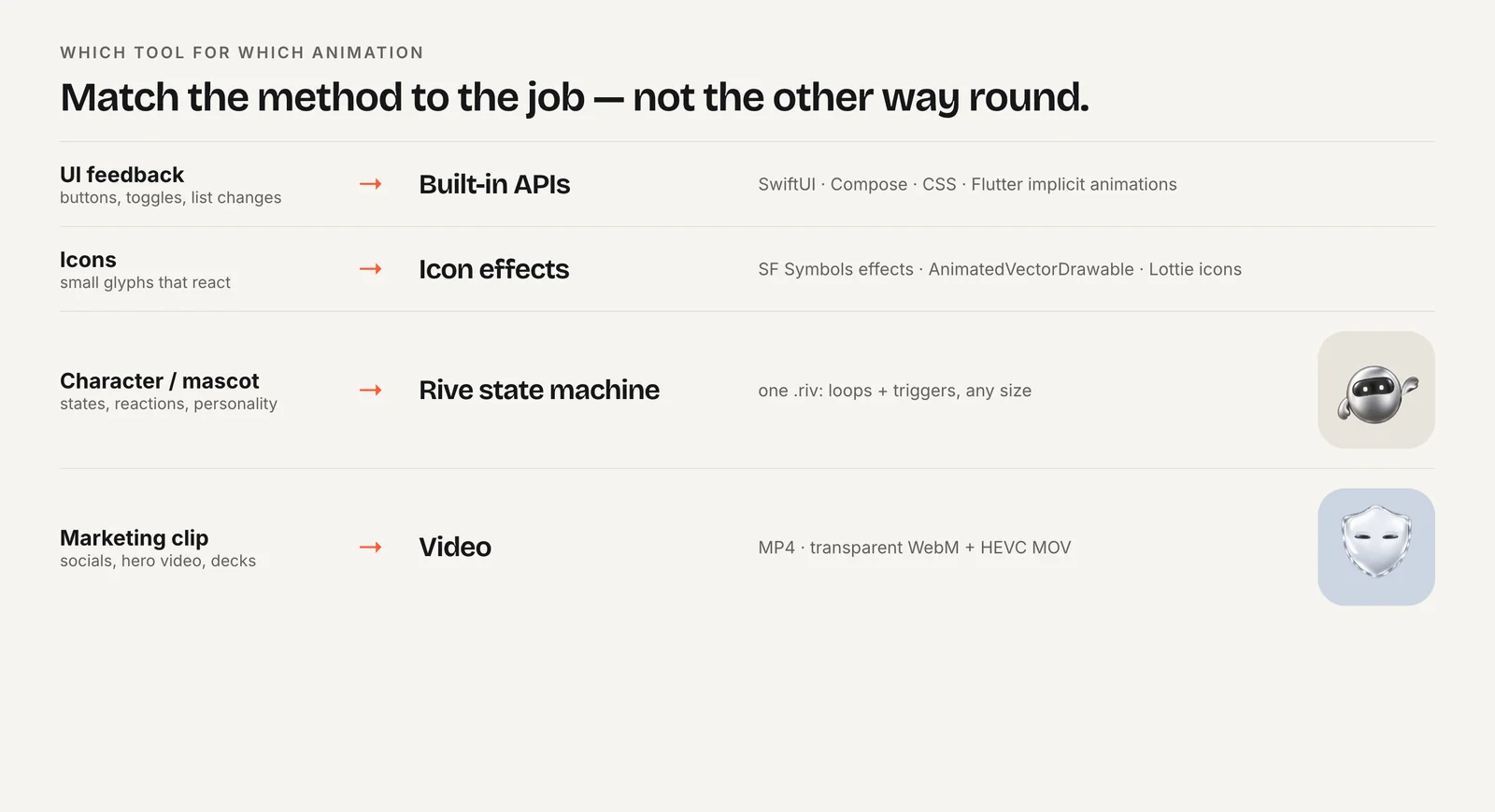
Video. If nothing needs to react to the user, video is the simplest alternative of all. MP4 plays everywhere, needs no runtime, and works in social posts, presentations and video editors. For a transparent background on the web you need a VP9 WebM with alpha for Chrome, Edge and Firefox plus an HEVC .mov with alpha for Safari. Rive can render video itself, but only on paid plans as of October 2026.
A practical pattern is to keep both: an interactive file where the app can drive it, and video copies for every place that can't. Charmotion is built around that pattern. You upload a character, mascot or logo image and get 17 animations in about 1–2 hours: one .riv with a Character view model (a mood number from 0 to 9 and triggers such as success and error), legacy CharacterStateMachine inputs, plus MP4, GIF and transparent WebM and MOV. Plans are Starter $4.99/month, Studio $29/month or Expert $499 one-time.
Which Rive alternative should you choose?
- Choose Lottie with dotLottie if your motion team uses After Effects and you need hover, click or simple state logic.
- Choose Spline if the subject is a real 3D object or scene the user can view from different angles.
- Choose Motion or CSS if you are animating your own interface rather than illustrated artwork.
- Choose your game engine if the animation lives inside gameplay.
- Choose video if it only needs to play, or must work outside an app or browser.
- Stay with Rive if you need one small file holding many states of a character, blends between them, and control from app code.
These aren't exclusive. A common stack is Motion or CSS for the interface, Rive for one character, and video copies for marketing. For format trade-offs beyond tools, see GIF vs WebM vs MP4 vs Lottie vs Rive.
Frequently asked questions
Is there a free alternative to Rive?
Several. Lottie players are free and open source, CSS and the Web Animations API cost nothing, and many video tools are free. Rive's own runtimes are MIT-licensed and its editor has a free plan, though free .riv exports play a Rive splash screen and video export needs a paid plan (October 2026).
Can Lottie do everything Rive does?
Not everything. dotLottie state machines handle inputs, pointer events, guards, tweened transitions and actions. Rive adds blend states, two-way data binding through view models, and rigging with mesh deformation in the same editor. For simple interactive icons the gap rarely matters; for multi-state characters it usually does.
Is Spline a 3D version of Rive?
Loosely. Both are browser-based editors with interactive exports, but Spline builds real-time 3D scenes while Rive builds 2D vector animation with state machines. Spline suits objects users orbit or explore; Rive suits flat characters and UI that must stay small and switch states quickly.
Does Charmotion replace the Rive editor?
For standard character sets, it can. Charmotion generates a finished .riv with 17 animations from your image, so you only need the free Rive runtime to play it. For custom interactions, bespoke rigs or unusual states, you would still use the Rive editor or hire an animator.
Sources
- Rive pricing — Rive
- Runtime sizes — Rive
- State machines are finally in Lottie Creator — LottieFiles
- dotLottie state machines: Specification — LottieFiles
- LottieFiles pricing — LottieFiles
- Exporting as code — Spline
- Framer Motion is now independent, introducing Motion — Motion
- Video with transparency — Jake Archibald