Fintech and Crypto App Mascots: Trust-First States
By the Charmotion team · Updated
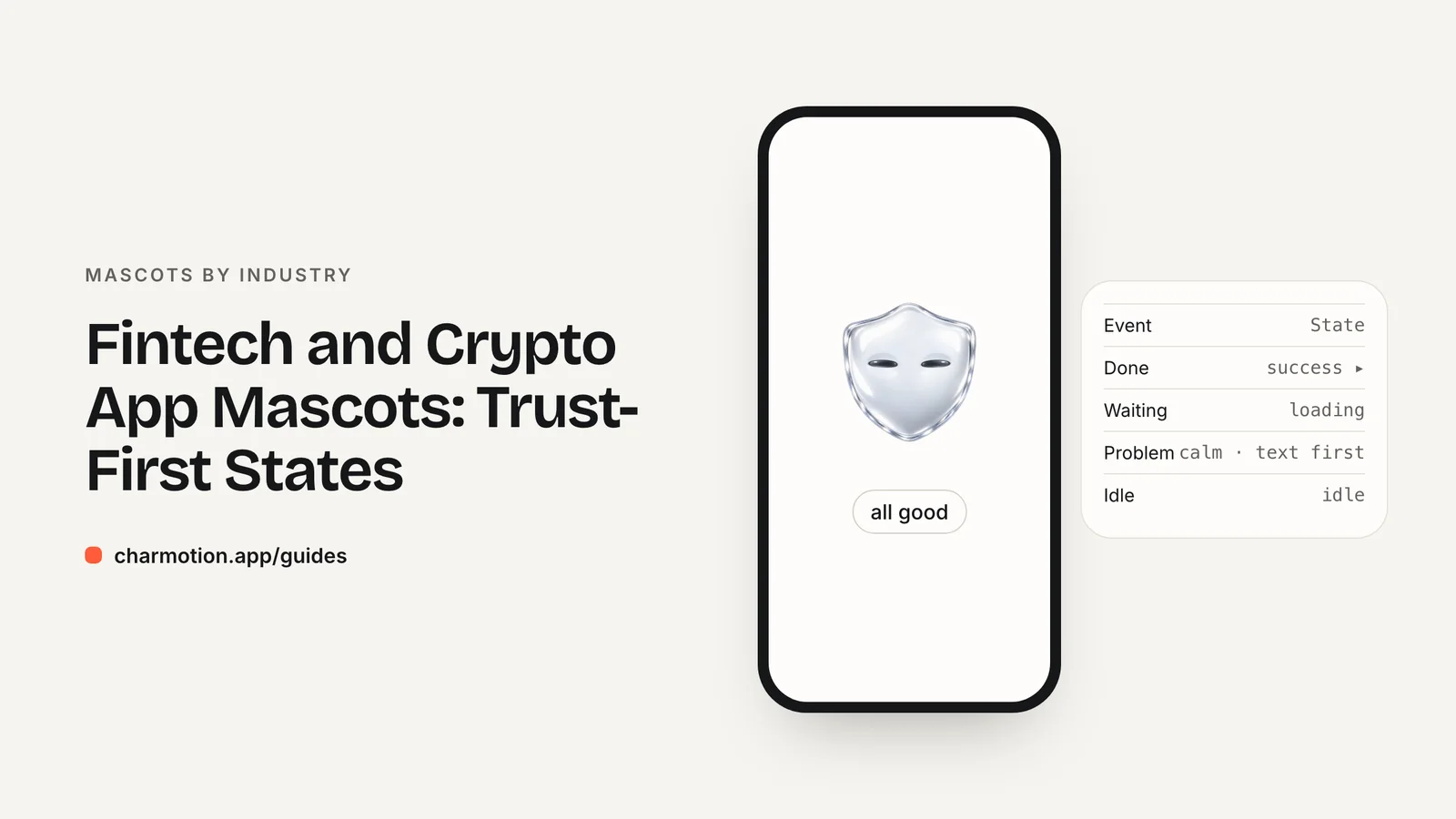
A fintech mascot can build warmth without hurting trust if it stays restrained. Use it for onboarding, empty wallets, waiting and brief success moments. Keep it neutral or absent on failed payments, fraud alerts, KYC steps and legal disclosures, where clear text and a next step matter more than personality. Never tie its mood to account balances.
Key takeaways
- NN/g found a conversational bank tone slightly raised trust, while a humorous insurance tone hurt credibility.
- Keep the mascot off failed payments, fraud alerts and disclosures, or limit it to a calm attention pose.
- Success reactions should be short and factual; the amount and recipient belong in text.
- Do not make the mascot react to price moves or portfolio value; it implies a judgment about the investment.
Already have a character or logo? Preview your own character animated in a phone splash, a website hero and an empty state — free, in your browser, nothing uploaded.
Does a mascot hurt trust in a finance app?
Not necessarily. The research points to tone, not the presence of a character, as the deciding factor.
In Nielsen Norman Group's tone-of-voice study, a more conversational version of a banking site was rated friendlier (+0.7 on a 5-point scale), more trustworthy (+0.3) and more likely to be recommended (+0.4) than the formal version. The same study found a humorous insurance site came across as "too chummy," with one participant saying the friendliness "takes away some of the credibility." Across the study, trustworthiness explained 52% of the variability in desirability scores (NN/g).
Research on characters in financial advice is more limited. In one lab experiment with 183 participants, anthropomorphic design in a robo-advisor chatbot raised perceived social presence, which in turn increased trust and willingness to follow its advice (Morana et al., ECIS 2020). That is an indirect effect in one setting, not proof that a mascot will make your app more trusted.
The practical reading: friendly is fine, jokey is risky, and every serious moment needs a character that can step back. A mascot that helps a nervous first-time user through onboarding is very different from one that dances on a payment screen.
Which money moments should never be animated playfully?
Some moments carry too much risk for anything but plain text and a clear action. Treat these as mascot-free or attention-only zones:
- Failed, declined or reversed payments. The user may be at a checkout counter. Speed and clarity matter more than empathy theater.
- Fraud and security alerts. Cute motion next to "Did you make this payment?" undermines the seriousness of the question.
- KYC and identity steps. Users are handing over documents; keep the screen focused and plain.
- Legal disclosures, fees and terms. Nothing should pull attention away from the text the user must read.
- Losses and price drops. In crypto and investing apps, do not let the character look sad on a falling chart or cheer on a rising one. A mascot that reacts to market moves implies a judgment about the investment.
- Debt, overdraft and collections notices. A smiling character here can read as mocking.
Outside these zones, the mascot has plenty of room: welcoming new users, filling an empty wallet or transaction list, waiting during a transfer, and confirming completed tasks.
How should the mascot react to a failed payment or a security alert?
Calmly, briefly, or not at all. The text does the work.
For a failed payment, there are two acceptable patterns. Either hide the character and show a plain error message, or play a short, restrained error reaction and settle into an attention loop next to the message. Avoid a sad face: the failure is the user's problem, not the mascot's feelings, and it can read as guilt. NN/g's error-message guidance applies directly: avoid humor, because it goes stale when the error repeats, and avoid phrasing that blames the user (NN/g).
A good failed-payment message states three things: what happened ("Your card was declined"), what it means ("No money was taken"), and what to do next ("Try another card or contact your bank"). The character should never cover any of it.
For a security alert, keep the mascot hidden or static. If you use motion at all, use the attention loop only, with no bounce, shake or flashing. The decision the user faces ("Was this you?") needs their full attention, and playful animation can make a genuine alert look like marketing.
How do I map mascot states to fintech screens?
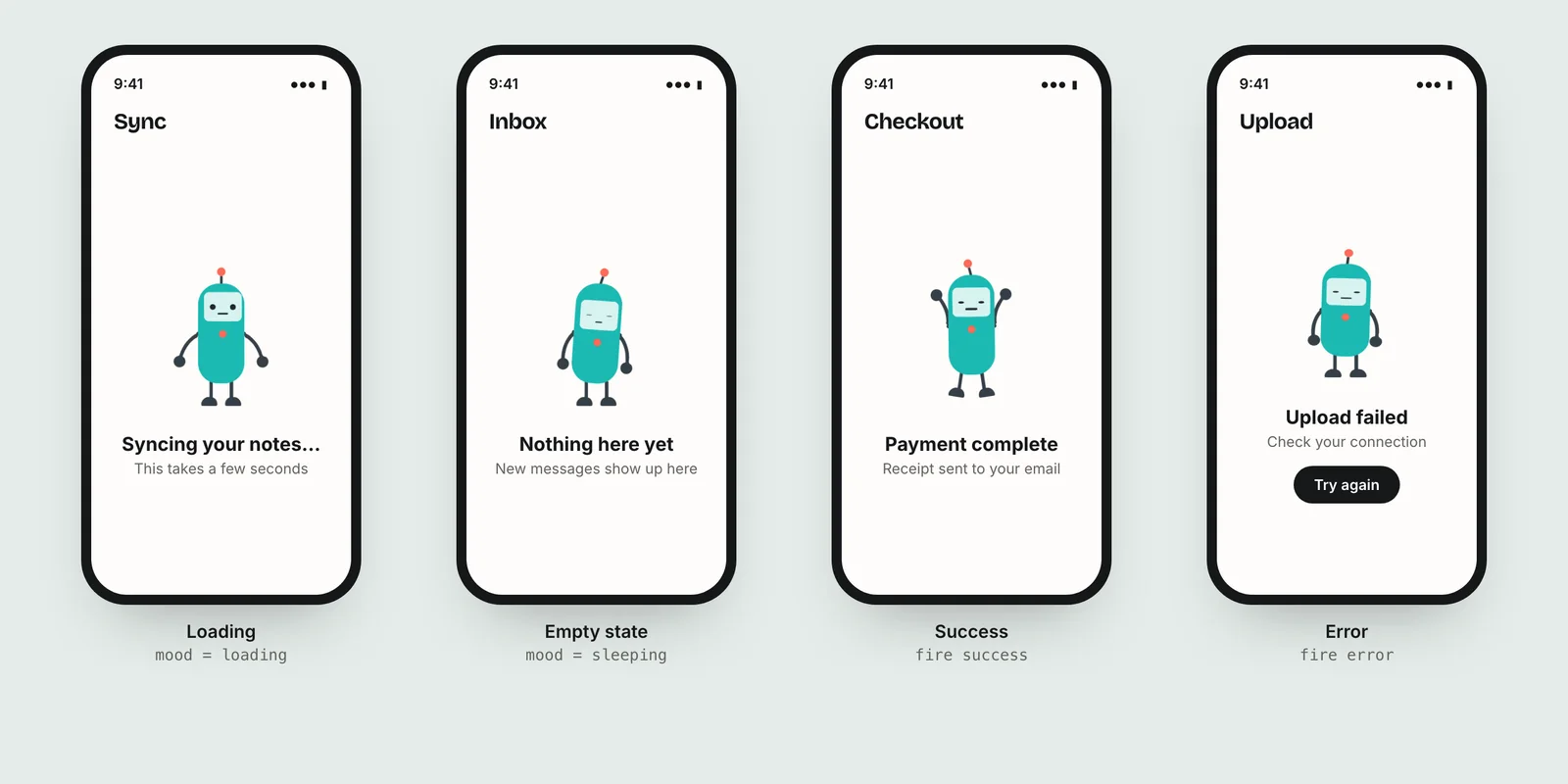
Start from your flows, then assign one state per event. This map assumes a standard ten-loop set with a mood number plus one-shot triggers:
| Event | State | Loop or one-shot | Notes |
|---|---|---|---|
| App opened | enter, or launch intro once | One-shot | Skip on repeat opens within a session |
| Onboarding welcome | wave (2) | Loop | Friendly tone is fine here |
| Empty wallet or no transactions | idle (0) or sleeping (8) | Loop | Pair with one clear action |
| Transfer in progress | loading (5) | Loop | Neutral; show a status line |
| Transfer complete | success, then idle | One-shot | Keep it brief; amount and recipient in text |
| Payment failed or declined | error, then attention (9), or no mascot | One-shot, then loop | Never sad; text explains the next step |
| Fraud or security alert | Hidden, or attention (9) only | Loop | No bounce, shake or flashing |
| KYC, fees, legal text | No mascot | — | Keep disclosures plain |
| Savings goal reached | success, then happy (1) | One-shot, then loop | A user milestone, not a market move |
States to leave out of a finance product entirely: sad (4), and talking (7) unless the mascot fronts a support chat.
Charmotion produces all of these from one upload: ten loops selected by mood 0–9, six one-shot triggers (success, error, yes, no, enter, exit) and a launch intro, in one .riv with Data Binding and legacy inputs. A calm character such as Aegis, a glass shield from Charmotion's demo set, illustrates the restrained end of the range.
Which fintech brands use mascots?
Few finance brands build their product around a character, but there are documented cases.
- Monobank, a Ukrainian neobank, has used an anthropomorphic cat as its official mascot since 2017 (Wikipedia).
- KB Kookmin Bank's Liiv app was built around a cast of characters that resemble charts and math symbols, and was entered at Cannes Lions as "Liiv: Life is full of character" (Cannes Lions). Performance figures in that entry are the bank's own.
Both cases are brand-led: the character is part of the identity across marketing and product. That is a bigger commitment than adding a mascot to a few screens, and it requires the same discipline about serious moments described above.
If you are considering a mascot for a finance brand, look at how such characters behave in error, alert and legal contexts, not just in campaigns. Those screens are where restraint is tested.
How do I keep the mascot out of regulated disclosures?
Treat disclosure screens as a hard boundary in your motion guidelines, and enforce it in code rather than relying on designers to remember.
- Make it a component rule. If your disclosure, terms and fee screens share a layout component, make that component render without a mascot slot.
- Do not animate near consent. Agree buttons, opt-ins and marketing permissions should never sit next to an attention loop or a happy character nudging the user forward.
- Keep the character out of financial claims. The mascot should not "say" anything about returns, rates or safety. Speech bubbles and talking states make it easy to slip into copy that needs compliance review.
- Review marketing reuse. A mascot clip used in ads may fall under the same review as any other financial promotion in your market. Ask your compliance team, not the animator.
This is design guidance, not legal advice. The rule of thumb is simple: wherever the user is reading something they are legally deemed to have understood, the mascot steps out.
How to add a mascot to a fintech app safely
- List money moments. Map every screen in onboarding, transfers, payments, alerts, KYC and disclosures.
- Mark exclusion zones. Remove the mascot from failed payments, fraud alerts, KYC, fees and legal text, or allow only a static or attention pose.
- Assign states to the rest. Use wave for onboarding, loading during transfers, success then idle for completions, and idle or sleeping for empty states.
- Write the copy first. Make sure every message states what happened and what to do next without relying on the character.
- Enforce rules in code. Build disclosure and consent layouts without a mascot slot and respect reduced-motion settings everywhere.
Frequently asked questions
Should a bank have a mascot?
It can, if the character stays restrained. NN/g found a conversational bank tone slightly increased trust, while humor hurt an insurer's credibility. Use the mascot for onboarding, waiting and success, keep it off failures, alerts and disclosures, and never let it make claims about money.
Should a crypto wallet mascot react to price changes?
No. A character that cheers on a rising chart or looks sad on a falling one implies a judgment about the investment. Tie the mascot to the user's own actions, such as a completed transfer or a backed-up wallet, not to market prices or portfolio value.
What should a mascot do when a payment fails?
Either disappear or play a short, restrained error reaction and settle into a calm attention loop. Avoid a sad face. The text should say what happened, whether money moved, and what to do next, and the character must never cover that message.
Quick answers from this guide
Sources
- The Impact of Tone of Voice on Users' Brand Perception — Nielsen Norman Group
- Error-Message Guidelines — Nielsen Norman Group
- The Effect of Anthropomorphism on Investment Decision-Making with Robo-Advisor Chatbots — ECIS 2020 (AIS eLibrary)
- Mono cat (mascot) — Wikipedia
- Liiv: Life is full of character — Cannes Lions (Love the Work)
- prefers-reduced-motion — MDN Web Docs